
Fitting an octagon bellows around a ball screw is a dimensional and alignment job, not a matter of fastening a flexible cover over the axis. You will learn how to measure the screw and nut envelope, select materials for Pune machine-shop conditions, install the fixed and moving ends, and verify safe travel before production.
Key takeaways
- Measure collapsed length, extended length, width and mounting details before ordering.
- Use coated fabric for chips and coolant; choose heat-resistant layers near sparks.
- Check full travel, fold clearance, drainage and fastener security after fitting.
- Provide machine drawings, hazard details and dimensions when ordering a custom cover.
How the octagonal bellows is built and why its shape matters
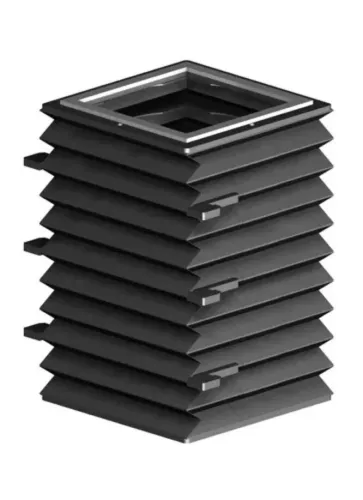
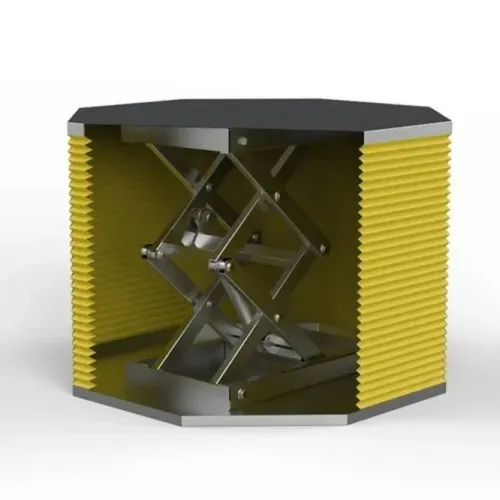
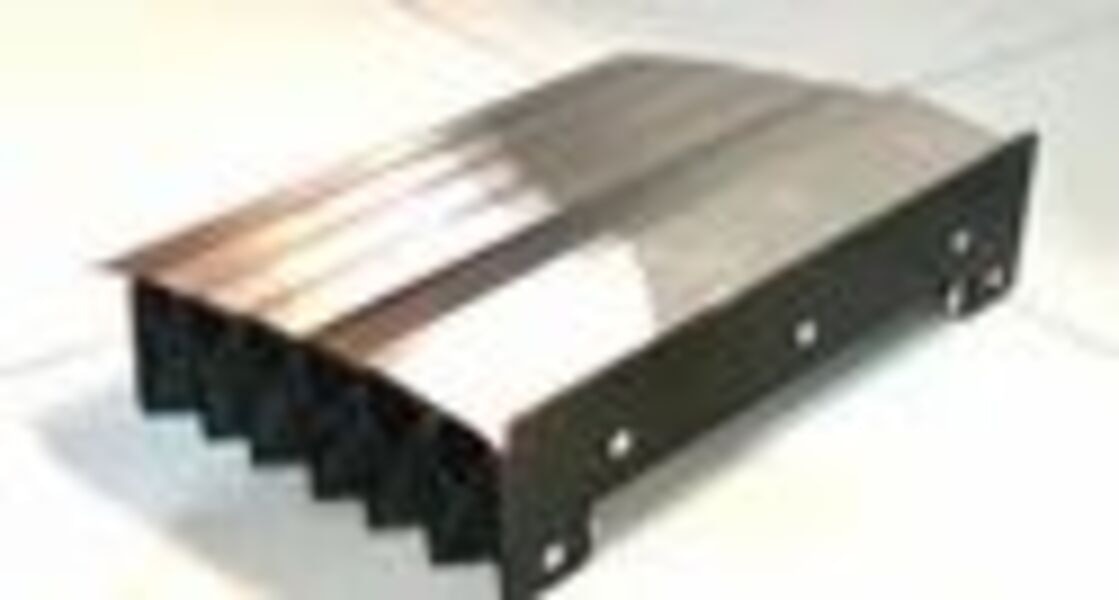
Eight folded sides define an octagon ball screw bellow cover in Pune, rather than a separate ball-screw mounting standard. Flexible fabric or coated-fabric layers form the bellows; seams are stitched or bonded, fold edges receive reinforcement, and end frames attach with clamps and bolts. Guide rings can control movement, while drain features prevent coolant pooling.
| Cover type | Envelope and access | Main limitation |
|---|---|---|
| Octagon bellow cover | Fits around the ball nut, lubrication fittings and nearby structure with efficient clearance | Must be designed from the actual nut and housing envelope |
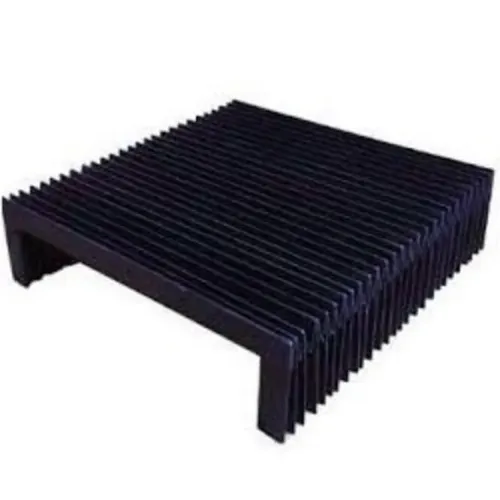
| Rectangular fabric bellows | Offers broad faces and useful access beside a guide or carriage | Wastes corner space around circular screw components |
| Round bellows | Suits cylindrical clearance around a screw | Leaves less usable access around flanges and fittings |
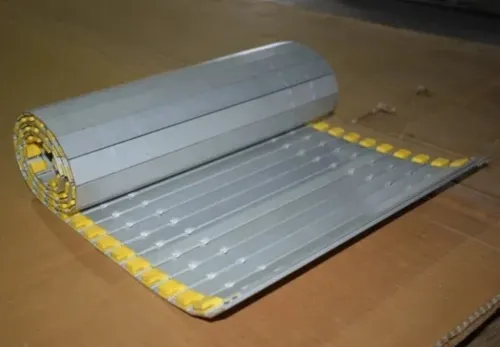
| Telescopic steel cover | Resists severe chip impact and falling swarf | Adds mass, space and moving inertia |
The normal arrangement uses one non-rotating end fixed to the machine housing and the other attached to the translating ball-nut carriage. Fit two covers when both sides of the nut require protection.
A ball screw bellow cover must clear the rotating screw, nut flange, bearing support and lubrication access; an LM-rail cover follows a guideway and uses different attachments and motion clearances. The octagon bellow cover is therefore a geometric solution, not a mounting standard.
Which measurements determine the cover’s collapsed and extended length
Use the fixed-face-to-carriage distance at both axis limits to set cover length; nominal ball-screw stroke alone is not enough. Record:
- Usable ball-screw travel
- Screw diameter, ball-nut outside dimensions and nut-flange size
- Lubrication nipple or tube position
- Bearing-housing clearance, radial envelope and maximum screw or nut overhang
- Carriage mounting-face dimensions and bolt-hole pattern
- End-frame thickness and allowable compression
A ball screw bellow cover changes length only between its two mounting faces. The screw may move through a full stroke while the fixed face stays still and the moving face follows the ball-nut carriage. A quotation must state collapsed length, extended length, number of folds, fold pitch and end-mount allowance.
| Measurement | What it controls | Failure if missed |
|---|---|---|
| Fixed-face-to-carriage limits | Bellows travel | Buckling or fold inversion |
| Collapsed length and compression | Minimum working length | Axial load or seam tearing |
| Nut, screw and bearing envelope | Radial clearance | Rubbing during motion |
| Mounting faces and holes | Attachment alignment | Pulled or twisted end frames |
Sizing from nominal stroke can force folds below their designed compression length. That creates rubbing, buckling, inversion, unwanted axial force or torn seams in a custom bellow cover in Pune.
Check clearance at maximum acceleration and at both travel limits. The cover must clear the rotating screw, ball nut, coupling, lubrication lines, limit switches, bearing supports and guideways. Keep end faces parallel and coaxial, and leave access for lubrication and inspection.
What happens during fitting in a Pune machine shop
Set the machine to a safe state before fitting. Lock out and tag out electrical, pneumatic and hydraulic energy, secure the axis against unexpected movement, and follow the machine builder’s access procedure.
1. Clean chips, coolant and oil from both mounting faces. Remove guards or obstructions only as the machine builder instructs; forced access can damage limit switches, cables or bearing supports.
2. Match the supplied end frames, clamps, fasteners, seals and drainage parts against the fitting drawing. Confirm that lubrication nipples, oil tubes and inspection points remain accessible after installation.
3. Attach the fixed end to the machine housing without twisting the octagon bellow cover. The cover must remain non-rotating for reliable ball screw protection in Pune.
4. Position the moving end on the ball-nut carriage with its centreline aligned to the screw. Mount both end plates parallel and coaxial; never pull an off-centre frame into position by tightening bolts.
5. Tighten flange fasteners evenly to the specified torque. Excessive tightening can crush the fabric, distort the frame or block a drain path.
6. Inspect every fold for equal opening, correct pitch and free movement. A folded section that is already compressed or inverted will fail during the stroke.
7. Jog the axis slowly through its complete travel, stopping at both limits. Check for screw contact, nut-flange interference, lubrication-line clearance, fold inversion, restricted travel and pulling at either end frame.
8. Increase speed only after the low-speed check passes without rubbing, noise or deformation. Confirm that the cover does not restrict rated travel before returning the machine to production.
How to match materials and protection to the machine’s hazards
Specify the construction from the hazard, not from the octagonal shape. Dry machining needs dust interception; coolant, sludge and oil demand verified chemical resistance; hot chips, welding spatter and abrasive dust need added barriers.
Ask for these process details before selecting ball screw protection in Pune:
- Coolant name and concentration, oil exposure, chip size and temperature, and welding spatter
- Ambient temperature, washdown pressure, motion speed, acceleration and cycle frequency
- Abrasive-dust load, monsoon moisture, coolant pooling and the required drainage route
Coated polyester, polyurethane-coated, neoprene-coated, silicone-coated and PTFE-coated fabrics are not interchangeable. Match chemical compatibility, flex-cycle life, minimum fold radius and temperature resistance to the process.
Add internal slats, external wear strips, or a separate heat-resistant and abrasion-resistant layer when sharp chips or spatter can strike the cover. Specify corrosion-resistant fasteners and protected seams for an octagon ball screw bellow cover in Pune, with drainage that does not discharge onto the screw or nut.
| Option | Protection and access | Trade-off |
|---|---|---|
| Fabric octagon bellows | Low moving mass; preserves access; encloses dust, coolant and fine chips | Fails under severe impact, direct jets or excessive heat |
| Telescopic steel covers | Handles large falling chips and heavy impact | Adds weight, space demand and moving inertia |
| Metal-flap covers | Deflects harsh swarf near exposed areas | Needs clearance and does not suit every compact envelope |
| Brushes or wipers | Improves wiping at an opening | Does not provide enclosed protection |
| Uncovered screw | No added mass or access restriction | Provides no ball screw protection in Pune |
Choose another or combined guard for large falling chips, high-pressure jets, excessive heat, or a stroke beyond the bellows’ compression and extension limits.
How to verify, maintain and order the fitted cover in Pune
A cover is ready for production only after it completes the entire rated stroke without contact, leakage or added axis resistance. Record the result; a visual check at one position proves little.
1. Run a slow full-axis travel test. At both limits, inspect fold symmetry, rubbing marks, loose stitching or clamps, trapped chips, coolant ingress, abnormal noise and any restriction at maximum travel. Increase speed only after the low-speed pass succeeds.
2. Set inspection intervals from cycle frequency and contamination level. At each check, remove chips without forcing folds apart, use only a cleaning agent confirmed compatible with the coating, and inspect seams, end plates, fasteners, drain paths and lubrication access.
3. Replace the cover when folds crack, stay permanently deformed, leak coolant, lose reinforcement, or fail to reach both travel limits without tension. Do not continue running a damaged cover as ball screw protection in Pune.
4. For a custom bellow cover in Pune, send machine photographs, an axis drawing, screw and nut dimensions, travel data, fixed and moving mounting details, bolt-hole pattern, speed, acceleration, cycle frequency, coolant and chip conditions, temperature and washdown information.
5. Ask whether the quotation includes end frames, clamps, guide rings, drain features, inspection access, replacement parts, site measurement and installation. With Kalavijay Engineering, confirm whether a technician visits, which measurements the supplier owns, and who handles alignment, machine access and the final travel test.
Related products
 | Bellow Cover We, " KALAVIJAY ENGINEERING" are masters in manufacturing and supplying excellent quality of Bellows covers. View product → |
 | SS Clad Bellow Cover We are Manufacturing Metal Flap Bellow Cover to prevent your Lm Rails and Ball Screw From metal Chips, Oill, Spatters, Coolant & Dust. View product → |
Frequently asked questions
How does an octagon ball screw bellow cover protect a machine?
Folded fabric or coated-fabric layers shield the ball screw from dust, chips, coolant, oil and mechanical wear. Reinforced folds, end frames and guide rings help the cover move with the screw.
Which measurements determine a ball screw bellow cover’s size?
Measure the collapsed length, extended length, cross-sectional width and height, ball-screw position, mounting-hole pattern and available clearance. Confirm the cover does not compress against the screw or nearby machine parts.
What happens when fitting an octagon bellow cover in a Pune machine shop?
The technician checks the mounting faces, installs end frames with clamps or bolts, aligns the cover with the ball screw, and runs the axis through its full travel. The final check looks for rubbing, snagging, coolant pooling and uneven folding.
How do you choose material for ball screw protection in Pune?
Match the cover to the hazard: use abrasion-resistant coated fabric for chips and coolant, oil-resistant layers where lubricants contact the cover, and heat- or spark-resistant construction near welding or hot swarf.
How do you verify and maintain a fitted bellow cover?
Inspect seams, fold edges, guide rings, drain features, clamps and bolts. Cycle the axis regularly, remove trapped chips, clear drains and replace the cover when cracks, holes, delamination or restricted movement appear.
Related products
 | Bellow Cover Some machines like the 5 axis grinding machine in the tool manufacturing industry require protection of the rails and ball screws from hundreds of... View product → |
 | Bellow Cover We are considered a well-known name in the business that manufactures and supplies CNC Bellow Cover. View product → |
 | Bellow Cover we are here to present an unparalleled assortment of Round Bellow Covers. View product → |