
A quotation that says only “aluminium apron cover” leaves the material, movement limits, interfaces and protection level unresolved. By the end, you will have a practical RFQ checklist for defining the cover, measuring the machine, comparing alternatives and setting acceptance tests.
Key takeaways
- Specify alloy, temper, thickness and material standard before comparing quotes.
- Measure apron cover dimensions from the machine and its full travel.
- Match seals, overlap and motion limits to chips, coolant, heat and sparks.
- Put failure checks, maintenance access and acceptance tests in the RFQ.
Start with the material and duty statement, not the product name
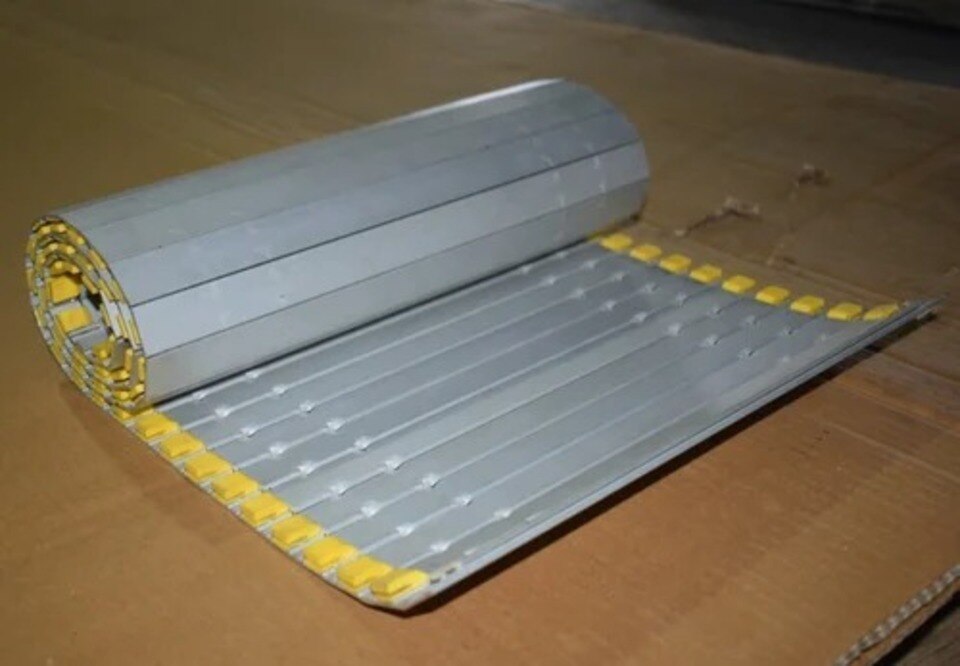
The aluminium apron cover specifications to check begin with the aluminium apron cover material: alloy, temper, sheet or strip thickness, applicable material standard and hardness where relevant. “Aluminium” does not define strength, formability, corrosion resistance or compatibility with steel hinges, fasteners and machine frames.
Request a material certificate when traceability matters, then state the finish, colour, coating thickness, masked areas and acceptable scratches.
Attach a duty statement containing:
- Installed orientation, closed length, maximum extended length and unsupported span
- Travel speed, acceleration, deceleration and cycle frequency
- Ambient temperature, chip type, coolant or oil exposure and cleaning method
Ask for a dimensioned general-arrangement drawing and slat section drawing. Require clear slat width, profile, thickness, overlap, hinge construction and allowable distributed or point load; these values determine resistance to sag, buckling, vibration and impact.
| Finish | Specify | Check before approval |
|---|---|---|
| Bare metal | Uncoated aluminium and acceptable scratch level | Coolant compatibility and exposed cut edges |
| Anodized | Colour, anodizing thickness and masked areas | Damage at cut edges and galvanic contact |
| Coated | Coating type, colour, thickness and masked areas | Chemical resistance and coating damage |
Treat finish separately from corrosion design. Require the supplier to address trapped coolant, damaged cut edges and galvanic contact with dissimilar metals.
Record apron cover dimensions from the machine, not from a catalogue
Measure the installed machine, not its nominal bed size: catalogue width and overall height cannot prove clearance at both end positions.
1. Record the usable opening, guideway or mounting-face width, guide-centre spacing, axis stroke, fixed and moving end positions, and clearance above, below and beside the moving structure. Mark travel direction and state whether the apron runs horizontally, vertically or inverted.
2. Measure the closed length, maximum extended length, retracted length or stack height, cover width, side-frame envelope, flange or bracket dimensions, mounting-hole pattern, fastener size and space required at both ends. Include the machine frame’s deflection, guide parallelism, cable and hose clearance, drainage path and cleaning access.
3. Check the interface while the axis is at both limits. Note whether the apron needs a supporting frame, guide rails, end stops or intermediate support, and whether any moving component, cable or hose enters the envelope. Measure apron cover dimensions from fixed datums, not from a worn or misaligned guard.
Ask whether quoted travel includes end allowances, and request dimensional tolerances for the cover, guides and mounting holes. Send axis-travel data, a dimensioned sketch and photographs containing reference measurements. The quotation should identify the mounting arrangement and every included clearance; otherwise a nominal dimension can conceal interference, inadequate support or poor drainage.
Match protection and motion limits to the actual contamination
Match aluminium apron cover specifications to the contamination first, because adequate slat alloy cannot prevent hinge seizure, guide blockage or leakage.
- Fine abrasive dust: specify brush or labyrinth protection and abrasion-resistant guides.
- Dry broken chips: confirm chip-clearance paths and slat overlap.
- Long stringy swarf: require hinge and guide protection; wrapping remains a specific risk.
- Heavy broken chips: state impact energy or chip mass and require impact-rated slats.
- Flood coolant: state concentration, leakage direction and drainage provision.
- Cutting oil: identify continuous contact, compatibility and swelling risks for seals.
- Hot chips: give maximum chip temperature and contact duration.
- Welding sparks: state spark frequency, heat exposure and whether a separate spark barrier is needed.
- Wash-down: state cleaning chemicals, water temperature and wash-down pressure.
Request written limits for maximum travel speed, acceleration and deceleration, cycle rate, direction-change frequency, vibration, slat deflection, bending or articulation, and allowable unsupported span. Confirm that each limit applies to horizontal, vertical or inverted installation.
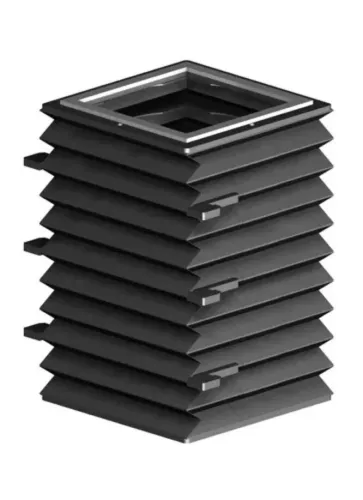
Describe side brushes, wipers, overlapping slat edges, labyrinth paths or flexible seals; ask which leakage direction they control and whether brushes are replaceable consumables. An articulated aluminium apron is not automatically chip-tight or coolant-tight.
Choose by contamination, flexibility, sealing and installation effort:
| Option | Best fit | Main limitation |
|---|---|---|
| Telescopic steel cover | Impact, chips and tight sealing | Less flexible and heavier |
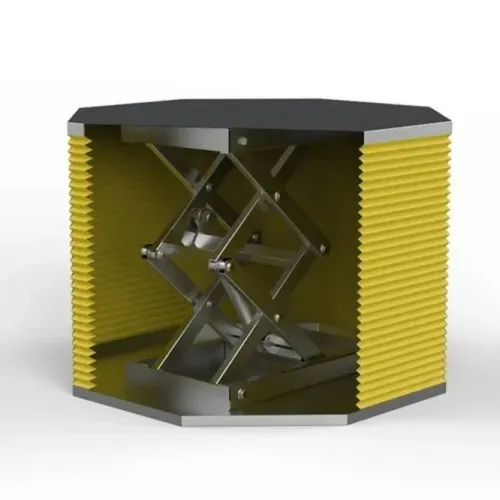
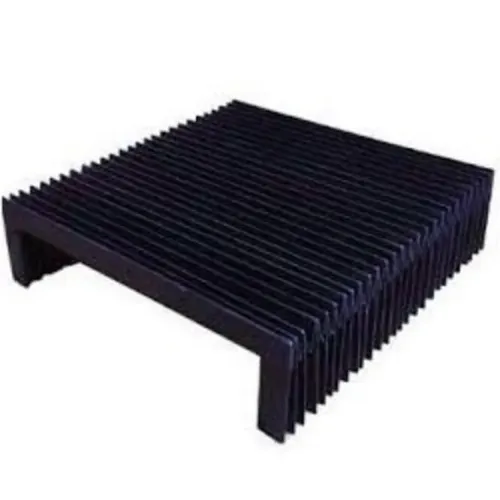
| Fabric or laminated bellows | Flexible three-dimensional movement | Lower impact resistance |
| Guideway wipers | Edge wiping | Not full-span coverage |
Specify failure checks, maintenance access and acceptance tests
1. Put failure modes and maintenance into the quotation. Ask the supplier to identify likely wear parts, inspection points, lubrication points and approved lubricant, cleaning intervals, and the replacement method for individual slats, hinges, brushes and guides.
Check hinge seizure from packed chips, slat-edge impact damage, abrasive guide wear, coolant entry at joints, fastener loosening, resonance, rubbing and slat flutter.
2. Require inspection access without dismantling unrelated machine components. State how an operator will remove chips, clean joints and guides, inspect fasteners and replace a brush or slat. The supplier must define written operating limits for speed, acceleration, temperature, contamination and cleaning chemicals.
3. Define the acceptance test before purchase. Record the required number of cycles, travel speed, acceleration, deceleration and representative chip or coolant contamination; use the actual hazard when it controls the design. Witness or obtain records for full travel at both end positions, maximum-speed cycling, interference-free movement, guide alignment, mounting security and end clearances.
4. Reject the cover for slat separation, abnormal noise, rubbing, leakage, loose fasteners or permanent deformation. “Fits the machine” is not acceptance. Require signed test results, a final general-arrangement drawing, spare-part identification and maintenance instructions.
If the cover contributes to personnel guarding, assess the complete arrangement separately against ISO 14120 and ISO 13857; do not infer a safety rating from machine protection alone.
Use the RFQ to test supplier capability, not just location
An aluminium apron cover manufacturer in Pune should prove engineering and service capability, not simply provide a local address. Request the Pune-area factory or service address, comparable application references, sample inspection records, dimensional drawings, spare-part lead times, installation responsibility and a documented warranty-response process.
Include Kalavijay Engineering in the comparison, but request identical evidence from every bidder.
Send every supplier the same machine measurements, duty statement, contamination description, interface drawing and acceptance-test plan. Require each quotation to identify:
- Alloy, temper, thickness, slat profile and overlap
- Guide arrangement, seals, allowable speed, acceleration and required support
- Brackets, guide rails, end stops, seals, drainage provisions and maintenance access
- Delivery scope, replacement-part availability and installation exclusions
Compare the technical offer on the same dimensions:
| Item | Ask the supplier to state |
|---|---|
| Material | Alloy, thickness, finish and corrosion-control method |
| Movement | Maximum speed, acceleration, cycle rate and installation orientation |
| Interface | Guide tolerances, support, clearances, mounting hardware and end allowances |
| Protection | Seal design and written limits for coolant, chemicals, sparks, hot chips and temperature |
| Service | Inspection evidence, warranty process and replacement-part lead time |
Do not accept “aluminium” as a fire or heat rating. For welding spatter, flame or unusually hot chips, request assembly-specific documentation or a test tied to the machine conditions. The strongest quotation states what is included, excluded and still requires confirmation.
Related product
 | Aluminium Apron Cover Protect your machine tool guide surface with the Aluminum Curtain from Kalavijay Engineering Machine Tool Accessories Producing Co., Ltd. View product → |
Frequently asked questions
Which aluminium apron cover material details should buyers specify?
State the aluminium alloy, temper, sheet or strip thickness, applicable material standard and hardness where relevant. Check compatibility with hinges, fasteners and the machine frame.
How should you determine apron cover dimensions?
Measure the machine directly, including guideway width, available height, travel, mounting points, compressed length and extended length. Do not rely on catalogue dimensions.
How do you match an apron cover to contamination and movement?
Identify the contaminants, temperature, impact and exposure pattern, then confirm seal design, overlap, allowable speed, acceleration, stroke and bend or lift limits.
What should an aluminium apron cover RFQ and acceptance test include?
Request drawings, material certificates, motion calculations, maintenance access details and failure checks. Define tests for full travel, interference, sealing, noise, fastening and service access.