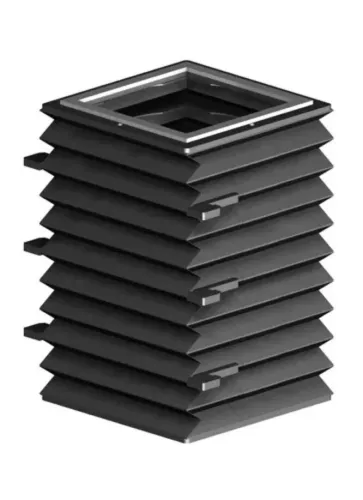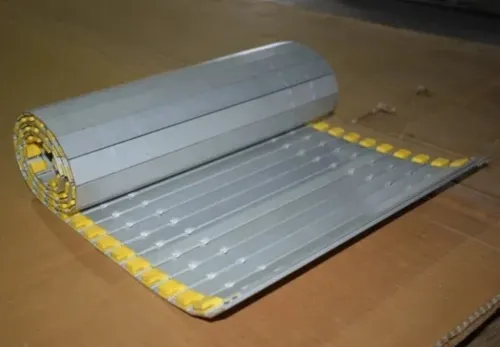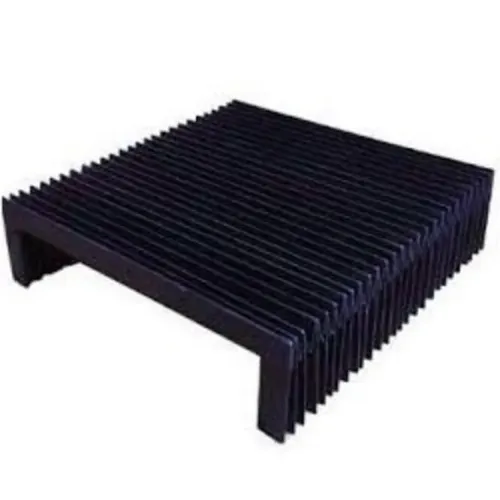

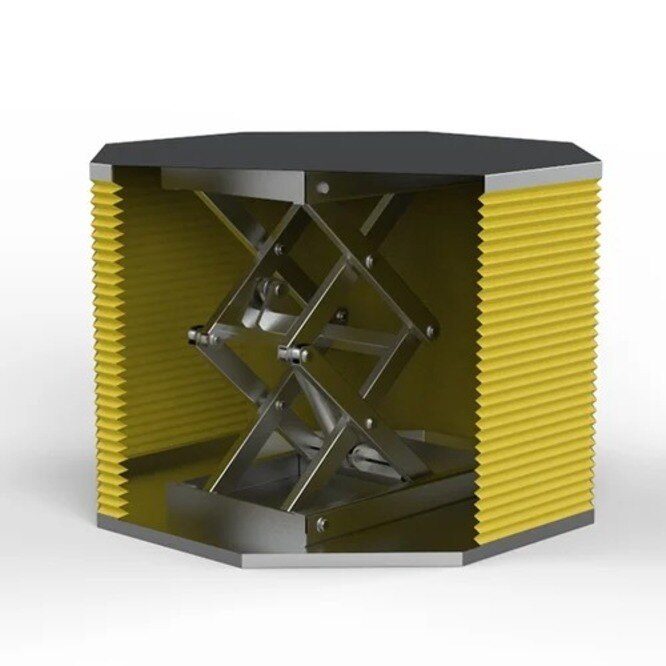
An urgent bellow replacement can create a new crush point, tear at the first lift cycle, or interfere with hydraulic hoses and scissor arms if the cover is treated as a simple fabric part. You will be able to isolate the lift, measure the mechanism, choose a suitable construction, check movement, and give a Pune supplier the information needed for a safe replacement.
Key takeaways
- Lock out the lift and install rated mechanical supports before removing the cover.
- Measure the opening, stroke, folds, mounting points, and compressed height—not just the damaged cover.
- Trace failures to travel interference, heat, chips, coolant, or incorrect mounting before ordering.
- Send drawings, photographs, dimensions, exposure details, and delivery requirements to the Pune supplier.
How to make the lift safe before removing the damaged cover
Make the lift safe before treating the damaged cover as a removal job. A scissor lift bellow cover is not load-bearing: it cannot support a raised platform, restrain scissor arms, or replace mechanical safety devices.
1. Stop the lift and keep people outside the danger zone. Lower the platform fully if the manufacturer permits it.
2. Isolate the electrical supply through lockout/tagout. Isolate the hydraulic supply by closing or disconnecting the specified isolation point, then release hydraulic pressure according to the lift manufacturer’s procedure.
3. Control stored energy in cylinders, accumulators, springs, and moving arms. Prevent scissor-arm movement with the manufacturer-approved restraints or blocking.
4. If the platform must remain raised, install the manufacturer-specified mechanical maintenance props or blocking before anyone enters beneath or between the structure. Never work beneath an unsupported raised lift.
5. Isolate pendant and panel controls against restart, then verify zero energy at the controls. Confirm that movement, pressure, and unintended descent cannot occur.
6. Before removing the damaged cover, identify pinch points around arms, rollers, pins, rails, hoses, and platform edges. Remove the cover only after this check.
7. Inspect the exposed opening and attachment rails for burrs, sharp edges, distortion, loose fasteners, contamination, and uneven alignment before fitting a scissor lift bellow cover replacement.
8. Decide whether the replacement preserves the original access controls, emergency-stop function, guarding arrangement, and safe clearances. A cover that changes access or creates an opening requires a new guarding assessment, not a like-for-like assumption.
How to measure a replacement cover when the original is damaged
Measure at both travel limits; overall length and width alone produce the wrong fold geometry. Record the fully compressed length, fully extended length, collapsed height, extended height, width, fold pitch, number of folds, stroke direction, and folded-pack dimensions.
Send the fabricator:
- A marked sketch showing the fixed end, travelling end, direction of travel, and every fixed or moving attachment point.
- Mounting-hole diameter, hole spacing, edge distance, flange dimensions, rail height, and fastener locations.
- Clearances to scissor arms, rollers, hydraulic hoses, guide rails, pins, cable carriers, platform frame, and floor.
- Photographs of the mounting area from several angles, with a ruler or scale visible.
- The machine model, serial number, operating temperature, contaminants, failed cover or sample fold, and any changed frame dimensions.
Measure with the lift isolated and inspect fully lowered, intermediate, and fully raised positions; a flat, static measurement misses lateral movement and torsion.
| Position | Record | Check |
|---|---|---|
| Fully lowered | Compressed length, collapsed height, folded-pack dimensions | Confirm the pack fits without touching arms, rails, pins, platform frame, or floor |
| Fully raised | Extended length, extended height, width, fold pitch and fold count | Confirm the cover reaches its travel without pulling seams or flanges |
| Both limits | Hole pattern, rail height, flange dimensions and all clearances | Confirm fixed and moving mounts stay aligned |
If the original is unavailable or dimensions changed, label the request redesigned cover and provide new travel, envelope, and mounting drawing—not like-for-like. A custom bellow cover in Pune still needs this machine-specific data; custom size alone does not define fold geometry or movement clearance.
How to find interference, recurring failure, and false fixes
A static fit cannot prove survival through a scissor lift’s full cycle. The arms change angle, lateral position, and torsion as they open, so a cover that looks correct at rest can pull, bunch, or snag in motion.
1. Keep lockout, hydraulic isolation, pressure release, blocking, and stored-energy controls in place. Manually cycle the mechanism only where the manufacturer permits it; otherwise run an approved, slow, no-load commissioning cycle.
2. Inspect the fully lowered, intermediate, and fully raised positions. Watch every fold near the scissor arms, rollers, hydraulic lines, cable carriers, guide rails, pins, platform edges, and floor.
3. Reject a cover that is too short at extension: it pulls its seams and end frames. Reject one that is too long when collapsed: it bunches into the mechanism and creates rubbing or a pinch hazard.
4. Before installation, find burrs, sharp edges, distorted rails, uneven fastener lines, loose hardware, contaminated guides, and damaged attachment points. A new cover fitted over a defective rail will repeat the old failure.
5.
Match each symptom to its likely cause: torn folds mean excessive compression, rubbing, or wrong fold pitch; detached flanges mean pull-out, misalignment, or loose fasteners; fabric abrasion means burrs or rail contact; oil swelling means incompatibility; spark burn-through means inadequate heat or spatter protection; water ingress means an unsuitable seam or mount; snagging during extension means an interference path.
For scissor lift bellow cover for replacement problems in Pune, do not add a thick patch or adhesive edge until you confirm it cannot catch during folding. Record the slow no-load cycle and release the lift only after intermediate-position checks pass.
How to choose fabric and construction for the actual exposure
Specify the cover by exposure, not by appearance. Ordinary dust and chip exclusion needs a flexible, abrasion-resistant fabric; direct welding spatter needs heat resistance, a sacrificial outer layer, protected seams, or metal guards.
| Option | Best match | Construction decision |
|---|---|---|
| Nylon fabric | Dry dust, light chips, repeated folding | Use only after checking abrasion and flex-life requirements |
| PU-coated fabric | Defined contamination and flexing duty | Poor default for oil, high heat, or hot sparks; verify chemical compatibility and temperature limits |
| Fire-resistant fabric | Flame or spatter exposure | Request the exact test standard and classification, including ISO 14116 when specified |
| Specialty elastomer-coated fabric | Hydraulic oil, coolant, liquid sealing, or outdoor water | Match the elastomer to the fluid, temperature, ultraviolet exposure, and cleaning chemicals |
| Sacrificial outer layer | Direct welding spatter or abrasive chips | Replace the outer layer without overloading the flexible bellows |
| Protected seams | Liquid ingress or hot-particle exposure | Specify seam placement, sealing, and reinforcement |
| Metal guards | Severe chips or concentrated spatter | Check added weight, clearance, and pinch-point risk |
| Segmented covers | Large travel or distinct exposure zones | Confirm segment joints cannot snag during folding |
Send the hydraulic-fluid or coolant name, its safety data sheet, ambient and contact temperatures, cleaning agents, and exposure frequency. State whether the scissor lift bellow cover in Pune must retain dust and chips, resist liquid ingress, tolerate direct spatter, or provide operator guarding; these functions are not interchangeable.
Confirm that the construction will not restrict travel or defeat access controls. A cover is not a substitute for guarding or mechanical safety devices.
What to send a Pune supplier and how to release the replacement
Send the quotation pack before asking a Pune supplier to promise a delivery date. A complete record lets a scissor lift bellow cover replacement address movement and interference, not just the visible tear.
1. Attach photographs from several angles, the machine model and serial number, and the failed cover or a sample fold. Include a drawing or marked-up sketch.
2. Record mounting-hole diameter and spacing, flange dimensions, fixed and moving attachment points, fully compressed and fully extended travel, operating speed, stroke direction, temperature, contaminants, and the delivery deadline.
3. State whether the request is like-for-like or a redesign. Identify every dimensional change around the scissor frame, including altered rail height, side clearance, or attachment position.
4. Ask the supplier to confirm in writing the material, fold geometry, number and pitch of folds, seam construction, mounting method, temperature range, chemical-compatibility basis, and any fire-test documentation. Kalavijay Engineering can assess a scissor lift bellow cover in Pune from these records instead of guessing from one photograph.
5. Before installation, inspect rails and fasteners for burrs, distortion, contamination, loose hardware, uneven height, and sharp edges that could cut the first fold.
6. Run a slow-speed, no-load cycle and inspect fully lowered, intermediate, and fully raised positions.
7. Record that the cover does not pull, bunch, snag, leak at its mount, or restrict travel.
8. Perform a loaded cycle only when the lift manufacturer permits it, then confirm that emergency-stop and access-control functions remain unchanged before releasing the lift.
Related product
 | Bellow Cover Material - PU Coted, Color - Black, Size - Customized, Advantages - To Avoid Accident, To Protect from Dust, Easy to Fitment, Cost effective. View product → |
Frequently asked questions
How do you make a scissor lift safe before removing a damaged bellow cover?
Isolate power, prevent unexpected movement, lower the platform where possible, and install rated mechanical supports before entering the danger zone or removing the cover.
How do you measure a replacement bellow cover when the original is damaged?
Measure the protected opening, required travel, extended and compressed lengths, fold count, mounting points, clearance, and attachment orientation from the lift itself.
What causes recurring scissor lift bellow cover failure?
Check for interference with scissor arms or brackets, incorrect compressed height, excessive fold loading, heat, chips, coolant, sparks, and mounting tension.
How should you choose fabric and construction for a scissor lift bellow cover?
Match the cover material, coatings, seams, guides, and reinforcement to the actual temperature, coolant, chips, abrasion, sparks, flame, and movement.
What should you send a Pune supplier before releasing a replacement cover?
Send dimensions, a marked-up sketch, photographs, movement details, exposure conditions, mounting information, failure history, and the required delivery date.