
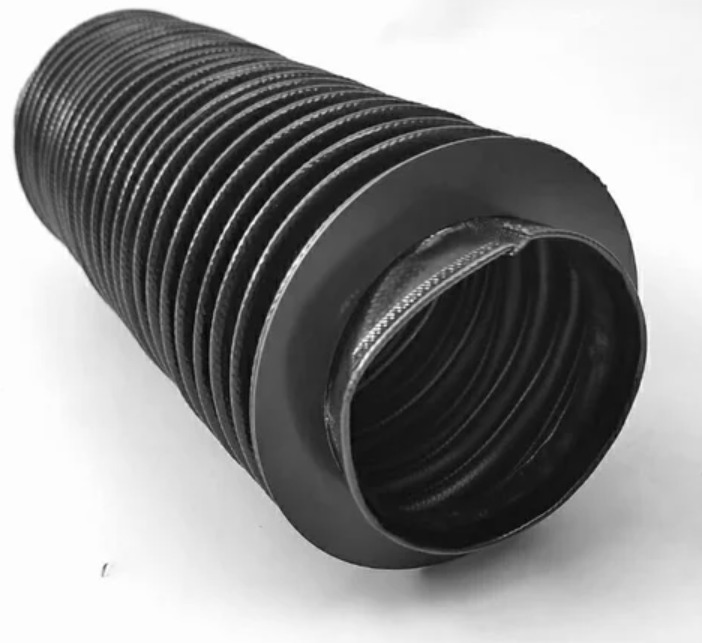
A Round Bellow Cover is designed to protect cylindrical or rod-like moving components while accommodating axial movement. It can be used around shafts, piston rods, screws, cylinders, and other machine components where a rectangular protective cover would not match the geometry of the application.
The circular construction allows the bellow to compress and extend along the component's axis. This creates a flexible barrier against dust, dirt, chips, and other contaminants depending on the selected material and operating environment.
Choosing the correct size begins with understanding the protected component and its movement. Four dimensions are particularly important: internal diameter, external diameter, extended length, and compressed length.
The internal diameter needs sufficient clearance around the shaft or component. If it is too small, the cover may rub during movement. The external diameter must fit within the surrounding machine space without interfering with nearby parts.
Extended and compressed lengths determine whether the bellow can accommodate the full stroke. A cover that reaches the required extended length but cannot compress into the available space is still unsuitable.
Before selecting a round bellow, engineering teams should record:
Diameter of the component being protected
Total operating stroke
Available length at full compression
Maximum permissible outside diameter
Mounting dimensions at both ends
Type of contamination present
Temperature and environmental conditions
Frequency and speed of movement
Material requirements should be evaluated according to exposure. A bellow protecting a component from ordinary workshop dust may have different requirements from one exposed to oil, coolant, heat, or abrasive particles.
Coimbatore is home to manufacturers and engineering units working with machine tools, pumps, automation, textile machinery, automotive components, fabrication, and special-purpose equipment. Round bellows can support many of these applications where moving cylindrical components need flexible protection.
Installation should avoid unnecessary twisting. The bellow should move primarily in the direction for which it was designed and should not continuously scrape against the protected shaft. Suitable end connections also help keep the cover positioned correctly throughout operation.
Kalavijay Engineering supplies machine protection solutions for industrial applications in Coimbatore. For a round bellow cover requirement, accurate dimensions and information about the operating environment are more useful than selecting by appearance alone.
A properly matched round bellow should provide enough clearance, compress within the available space, extend through the complete stroke, and remain stable during repeated movement. Getting these fundamentals right can improve the practicality of the installation and simplify ongoing machine maintenance.