
An “anti-static” label does not tell you how a bellow discharges charge, whether it remains effective after repeated folding, or whether it suits your machine’s travel and contamination. Before ordering, you will be able to define the electrical target, measure the machine, compare fabric bellow cover materials, and request an acceptance test that matches the installed assembly.
Key takeaways
- Choose insulating, static-dissipative, or conductive fabric based on your electrical risk.
- Provide travel, compressed length, extended length, opening size, speed, and acceleration.
- Match fabric, coating, seams, and reinforcements to chips, coolant, heat, and abrasion.
- Require material data, electrical test results, drawings, and a movement test before acceptance.
What does anti-static mean for a machine-tool bellow?
“Anti-static” does not identify the electrical behaviour of a machine-tool bellow. Decide whether you need an insulating, static-dissipative, or conductive cover before comparing anti static bellow cover specifications.
| Construction | Resistance comparison | Decision |
|---|---|---|
| Conductive | Below 10^4 ohms | Use where rapid charge transfer is required |
| Static-dissipative | 10^4 to below 10^11 ohms | Use to control charge without making the cover a conductor |
| Insulative | 10^11 ohms or more | Use only where charge control is not required |
These bands are a common ESD comparison, not a universal specification. Treat anti static fabric bellows as unverified until the supplier provides:
- The applicable standard, resistance limit, test method, electrode arrangement, conditioning temperature and humidity, and test location.
- The measurement type: surface resistance, volume resistance, or resistance-to-ground. These results are different and cannot replace one another.
- The conductive mechanism—yarn, carbon-loaded coating, mesh, or grounding strip—and a drawing showing its path through mounting hardware to verified machine ground.
- Continuity across seams, hems, isolated panels, clamps, frames, and moving sections. Painted frames, anodized surfaces, insulating clamps, seam allowances, and poor bonding can break the path.
- The intended hazard: static control matters near flammable vapour, combustible dust, electrostatic-sensitive electronics, or charged plastic film. It does not make the cover explosion-proof; hazardous-area classification, bonding, grounding, and ignition controls remain separate requirements.
Ordinary fabric protection is sufficient when charge cannot damage equipment, ignite an atmosphere, or interfere with the process.
Which fabric bellow cover materials match your contamination and temperature?
Match the complete laminate to the contamination and temperature, not the fabric name alone. The substrate supplies tear strength; the coating controls much of the fluid, abrasion, and heat performance.
| Option | Suitable duty | Check before ordering |
|---|---|---|
| Coated polyester or polyurethane | General flexibility, tear strength, fluid resistance, and cost | Confirm named coolant and oil compatibility |
| PVC-coated fabric | General coolant and chip duty | Check solvent, heat, and welding-spatter limits |
| Rubber-coated fabric | Flexible covers exposed to selected oils | Verify the exact oil and temperature range |
| Aramid or other heat-resistant fabric | Hot swarf and sparks | Confirm the coating and seams carry the same heat rating |
| Silicone or fluoropolymer | Higher heat or specific chemical exposure | Request compatibility data for each named chemical |
Identify what supplies the electrical function in anti static fabric bellows: conductive yarn, carbon-loaded coating, conductive mesh, or a topical anti-static additive. Yarn or mesh can lose continuity after cutting or poor bonding; carbon coatings can crack at folds; migratory additives can lose performance after washing, solvent exposure, ageing, or humidity changes.
Describe the service with dry chips, abrasive dust, alkaline wash, tramp oil, welding spatter, and hot swarf. Request data for abrasion, tear strength, flex-fatigue cycles, named coolant and oil compatibility, continuous temperature, short-duration peak temperature, cold-start flexibility, and flame behaviour.
Require resistance and charge-decay results at the lowest and highest expected humidity, not only at room temperature.
What machine dimensions and motion data belong in the order?
Measure the protected envelope, not merely the visible gap. Record the full width, height, and length of the rail, ball screw, guideway, cable, or moving component that must remain covered; the envelope can expand around guides and fittings.
1. Identify the fixed mounting face and moving mounting face. Record folded length, extended length, compressed height, overall width and height, number of pleats, pleat pitch, movement direction, minimum bend radius, axis travel, maximum speed, acceleration, cycle frequency, orientation, and expected service cycles.
2. Measure available end-of-stroke space, not only nominal travel. Check clearance through the complete motion around rails, ball screws, tooling, coolant lines, chip conveyors, cable carriers, guards, and fasteners. Reserve room for folds, the mounting flange, guide frame, and support rings.
3. Photograph both ends and provide a scaled drawing showing the mounting-hole pattern, clamp width, attachment faces, overlap direction, seam orientation, and folded dimensions. Include the allowable travel speed and minimum fold radius of the finished assembly in the anti static bellow cover specifications.
A flat gap measurement cannot define a safe cover. Ask for the anti static fabric bellow cover for details, including interference checks and the completed assembly dimensions. A material that meets an electrical resistance target can still buckle, rub, snag on tooling, or wear through during rapid repeated movement.
Which construction details prevent wear, leakage, and snagging?
Choose the construction for the mechanical and contamination duty, not the anti-static label alone. Stitched seams stay flexible and are easy to repair, but needle holes can admit coolant. Welded or bonded seams reduce leakage when the fabric and coating are compatible; the joint must still survive repeated folding.
| Construction | Advantage | Failure or clearance risk |
|---|---|---|
| Stitched seam | Flexible, serviceable repair | Coolant leakage through needle holes |
| Welded or bonded seam | Better fluid sealing | Joint failure if incompatible or repeatedly folded |
| Guide frame or support ring | Holds shape on wide, vertical, unsupported covers | Adds mass, clearance needs, and snag points |
| Rivets or eyelets | Strong attachment points | Need backing and sealing; exposed heads catch chips |
Add pleat reinforcements and wear strips where folds rub guides or abrasive chips. A continuous mounting flange or clamped edge usually seals better than isolated tabs. Velcro permits inspection but collects swarf and can open under coolant pressure; zippers ease access while creating a leakage path.
Specify whether sparks, hot chips, coolant spray, or repeated folding controls the choice. Check every fastener, overlap, seam, and reinforcement against the moving way. In fabric bellow cover materials, a conductive yarn or mesh can be interrupted by a cut, stitched hem, replacement panel, or nonconductive adhesive; carbon coatings can crack at folds.
Include those interfaces in the electrical design of anti static fabric bellows rather than treating the fabric as one continuous conductor.
What supplier documents and installation tests should you require?
Require a drawing and a finished-assembly test report, not only a material data sheet. Ask the supplier for anti static bellow cover for details covering the fixed and moving ends, mounting method, clamp or frame material, grounding points, seam and overlap orientation, folded and extended dimensions, and clearance to the protected way.
1. Request anti static bellow cover specifications that state whether the construction is insulating, static-dissipative, or conductive. The report must name the resistance limit, test method, electrode arrangement, conditioning temperature and humidity, and test location.
Require resistance results for the assembled cover, including seams, hems, reinforcement strips, mounting frames, sliding interfaces, and the intended ground connection. A flat coupon does not represent a folded cover.
2. After installation, place one probe on the conductive fabric, coating, yarn system, or grounding strip at the most distant panel and the other on a verified machine-ground point. Repeat the measurement at folds, seams, mounting hardware, and moving sections with the cover extended and compressed.
Record each result against the agreed acceptance limit; continuity alone does not prove charge decay or grounding quality.
3. Ask how resistance is retained after flexing, cleaning, oil, and coolant exposure. Name the approved cleaning agent, repair material, inspection method, re-test interval, and action required after a tear repair, coating patch, fastener replacement, or cleaning.
Kalavijay Engineering is one supplier you can ask to document these electrical interfaces and finished-assembly results rather than accepting an unspecified anti-static claim.
Related product
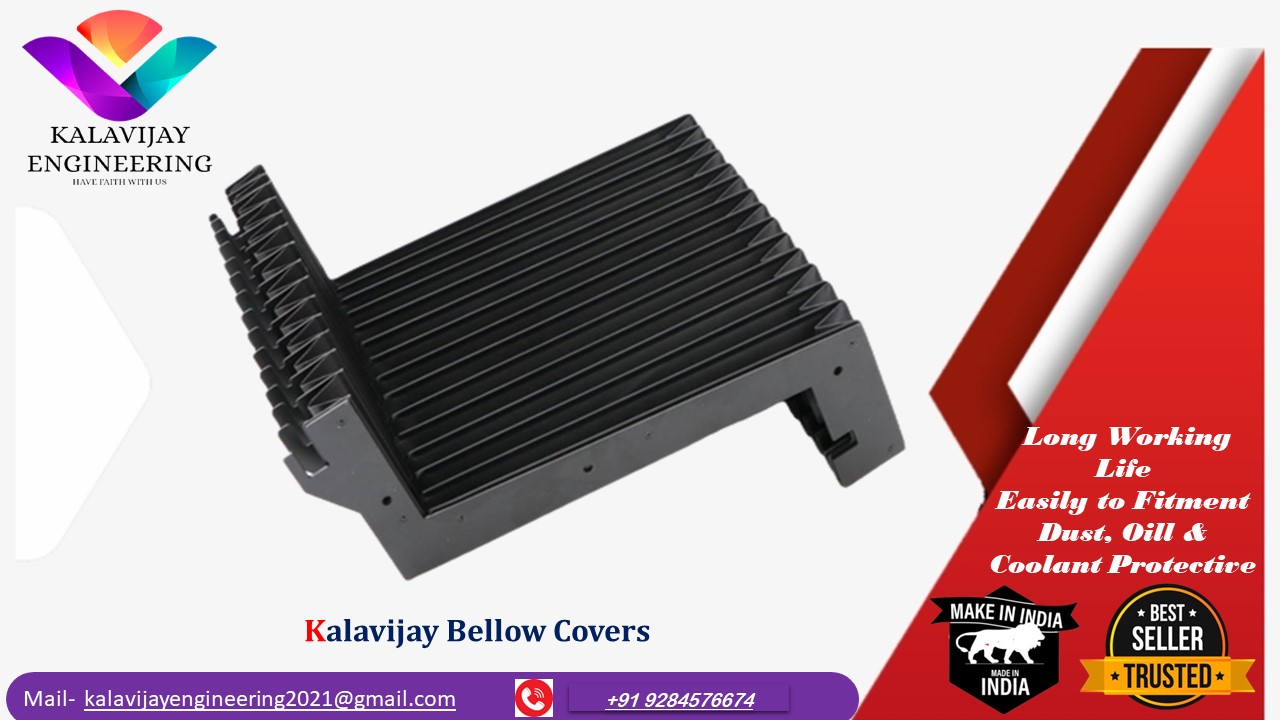 | Bellow Cover Anti Static Fabric Bellow Cover Kalavijay Engineering is considered a renowned name in the field that manufactures and supplies Steel Telescopic Cover. View product → |
Frequently asked questions
What does anti-static mean for a machine-tool bellow?
Confirm whether the cover is insulating, static-dissipative, or conductive, then match that behaviour to your machine’s electrical and contamination risks.
Which fabric bellow cover materials match contamination and temperature?
Choose fabric, coating, and reinforcement for the actual chips, coolant, oil, dust, sparks, spatter, and operating temperature they will encounter.
What machine dimensions and motion data belong in the order?
Provide opening dimensions, travel, compressed and extended lengths, speed, acceleration, mounting details, and the motion path’s clearances.
Which supplier documents and installation tests should you require?
Request material and electrical test data, a dimensioned drawing, mounting instructions, and checks for full travel, leakage, wear, and snagging.