
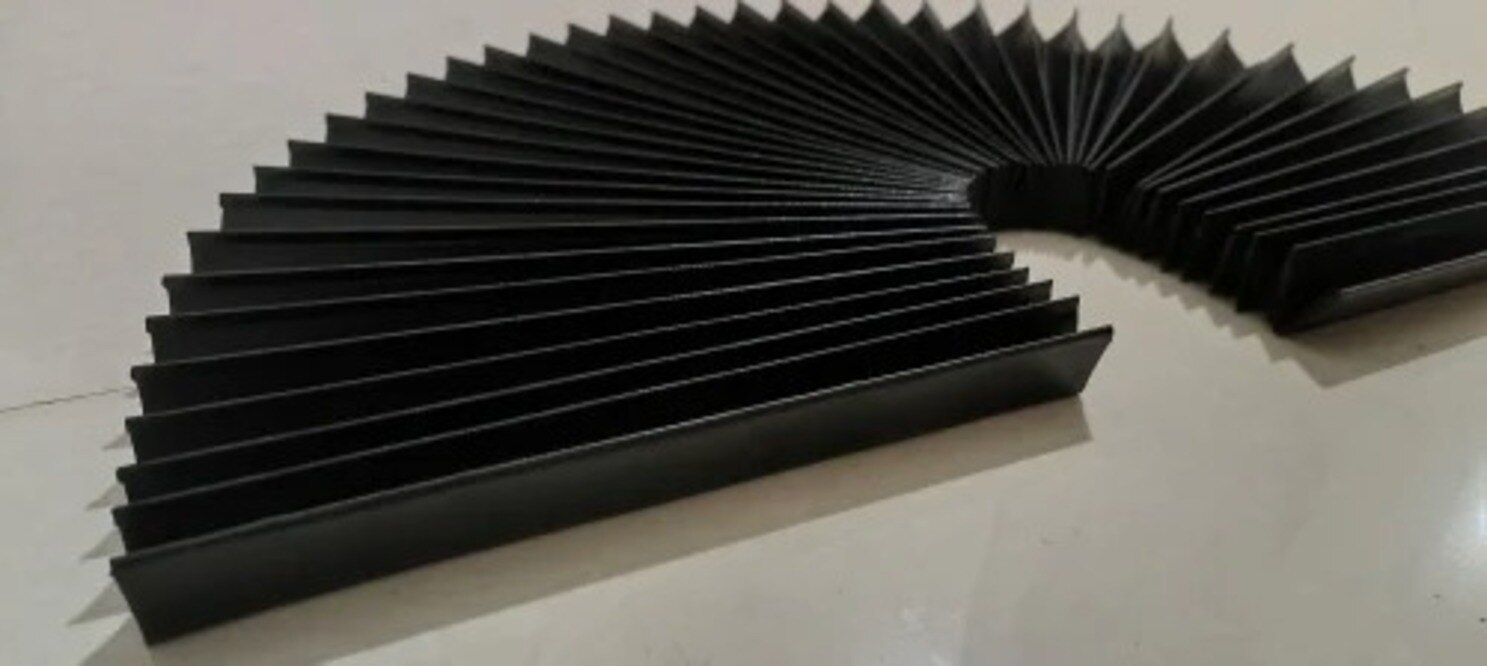
A damaged flat bellow cover can be repaired only when the material, folded geometry and mounting remain sound. You will learn how to inspect each fold, choose between an on-machine patch, workshop repair and full replacement, clean the cover safely, and record the measurements needed for reliable recovery or remaking.
Key takeaways
- Repair isolated tears; replace covers with brittle material or distorted folds.
- Use compatible PVC patches or coated-fabric repairs, not ordinary adhesive tape.
- Clean folds without trapping chips, and inspect the cover on a fixed schedule.
- Record stroke, width, height, mounting details and damage before ordering recovery.
Decide Whether the Cover Needs Repair, Recovery or Replacement
Choose repair for local damage, recovery for a rebuildable section, and replacement when the cover has lost its material strength or fold geometry.
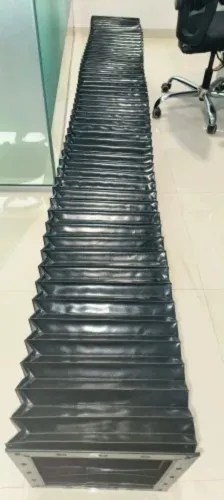
1. Stop and isolate the machine. Extend the cover fully and inspect every fold, weld, seam, corner, wiper contact, mounting strip and end frame. Look for split welds, pinholes, punctures, torn folds, detached flaps, loose mounting strips, exposed reinforcement, distorted frames and coolant leaking through seams.
2. Compress the cover slowly and inspect the folds again. Compression reveals cuts hidden in open folds, repeated cracking, rubbing marks, delamination between fabric and coating, hardened PVC and places where coolant has saturated the laminate.
A local pinhole, small cut, detached flap or limited frame damage can support flat machine bellow cover repair or recovery. Repeated cracking across several folds, widespread delamination, brittle or heat-shrunk material, a large tear or lost fold shape points to complete replacement.
3. Find what caused the defect before choosing the remedy. Run a finger carefully along accessible frame edges, then check for a burr, protruding screw, loose fastener, rubbing guide, distorted rail or side-loaded installation.
Unequal fold opening, twisting or contact with a way surface, ballscrew support, hose pack or fixed guard indicates a geometry or clearance fault, not merely damaged fabric. Correct that cause first; otherwise a new patch or cover will fail in the same place. After repair, verify the entire stroke at reduced speed.
Choose the Right Repair Method for PVC and Coated Fabric
A small, clean cut in sound 1 mm hard PVC can sometimes be repaired on the machine with a compatible heat-welded patch. Remove the cover for workshop repair when the material is brittle, coolant-soaked, oil-contaminated or heat-shrunk; heat and pressure can be rejected, or the surrounding PVC can crack beside the repair.
| Material | Suitable repair approach | Main warning |
|---|---|---|
| PVC-coated fabric | Use the specified adhesive or welding method | Heat or solvent can soften the coating |
| Polyurethane-coated fabric | Use a compatible PU repair system | PVC products may not bond reliably |
| Rubberized fabric | Use a rubber-compatible patch and adhesive | Coolant exposure can weaken the bond |
| Laminated multi-layer fabric | Seal the laminate path on both faces | A surface strip can leave hidden entry routes |
Clean and dry the area completely before patching. Size the patch beyond the damaged zone on every side, open and seal both sides of a tear where access permits, and close the path into the laminate rather than covering only the visible opening.
Otherwise, coolant and chips can enter through capillary gaps and separate the layers.
Do not patch a cover when the folded shape, reinforcement, mounting edge or frame has failed. A repaired surface cannot restore lost fold geometry, and a sharp rail or protruding fastener will cut the new patch from behind.
For a flat bellow cover for repair in coimbatore, provide the material type, fluid exposure and photographs of both faces before choosing heat welding, adhesive repair or replacement.
Clean the Folds and Follow a Flat Bellow Cover Maintenance Schedule
A usable flat bellow cover maintenance routine starts with removing chips before the cover compresses. Trapped abrasive particles grind against coated fabric during repeated extension and compression, eventually puncturing the laminate.
1. Daily, stop the machine and clear chips with a soft nylon brush, industrial vacuum or low-pressure air directed away from the folds. Check for coolant pooling, fresh cuts, rubbing marks and uneven fold movement. Do not use a sharp scraper or high-pressure air; it can drive debris deeper into the laminate.
2. Weekly, extend the cover fully and inspect every fold, seam, corner, wiper contact and end frame. Look for exposed reinforcement, loose threads, hardening, coolant saturation and new delamination. Damage hidden in compressed folds is easy to miss.
3. During machine servicing, check fasteners, mounting strips, guides and burrs. Confirm clearance around ballscrew supports, hose packs, fixed guards, way surfaces and adjacent covers. A protruding screw, sharp rail or side-loaded guide can cut the cover from inside and repeat the original failure.
4. Wipe cleaned surfaces with a lint-free cloth and mild detergent approved for the cover material. Rinse only when the machine and cover design allow it, then dry the cover completely. Aggressive solvents can attack PVC, polyurethane or rubber coatings.
For storage or transport, clean and dry the removed cover before folding it. A damp, coolant-contaminated cover can develop odour, coating degradation, reinforcement corrosion and permanent fold set. Never store it tightly folded while wet.
Record the Measurements Before Ordering Repair or Recovery in Coimbatore
Measure the machine’s actual travel, not just the cover’s outside dimensions. A short cover pulls tight at full extension; an overlong cover buckles into the guideway and can damage folds, guides or mounting frames. Record the operating envelope for a flat bellow cover for repair in Coimbatore or a replacement section.
1. Measure extended length, compressed length and usable stroke. Record overall width, usable opening width, fold height and total fold count.
2. Record guide clearance at the narrowest points, then measure both end frames: length, width, thickness, mounting-hole positions, hole diameter, fixing orientation and direction of travel. Note whether each fixing faces upward, downward, inward or outward.
3. Photograph both mounting ends with a ruler visible. Mark left and right on the cover and sketch the direction of travel; reversed orientation can twist folds or shift the mounting holes.
4. Identify every machine fluid and contaminant contacting the cover, including coolant, cutting oil, hydraulic oil, grease, welding spatter, dust and metal chips. These details affect whether a repair material will bond or fail.
5. Send the original cover when geometry is uncertain. If that is impossible, provide a full-scale mounting sketch showing frame edges, hole centres, clearances and fold positions.
For bellow cover recovery in Coimbatore, Kalavijay Engineering can use these operating-envelope and attachment records to assess a repair section or remade cover without guessing from outside dimensions alone.
Related product
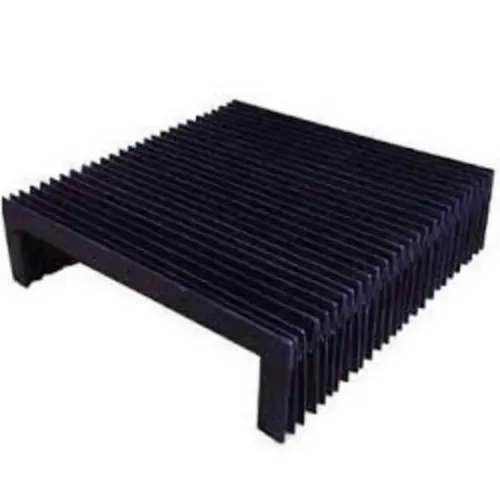
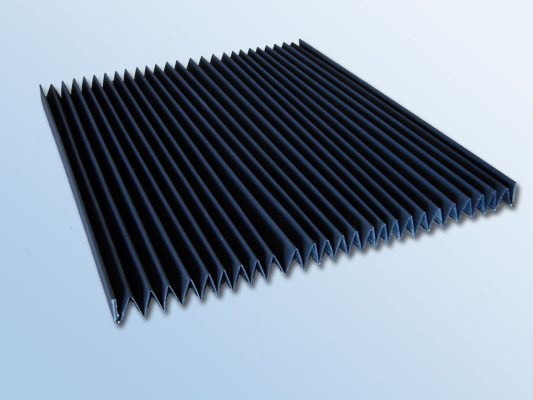 | Bellow Cover Kalavijay Engineering We Manufacturing Flat Bellow Covers in Customizes Width & Length. View product → |
Refit the Cover, Correct the Cause and Test the Complete Stroke
A repaired cover will fail again if the burr, misaligned rail or protruding screw that damaged it remains in place. During flat machine bellow cover repair, handle the cover through its end frames or designated mounting parts; pulling the fabric can tear the attachment edge.
1. Before fitting, remove sharp frame edges, straighten distorted mounting rails and secure or replace protruding fasteners. Check every fold, seam, end frame and mounting strip for damage missed while compressed.
2. Attach the cover without stretching the fabric. Confirm that folds open evenly, with no twisting, side loading or contact with way surfaces, fixed guards, hose packs, ballscrew supports or adjacent covers.
3. Run the machine through its complete travel at reduced speed while watching the folds and end frames. A static check cannot prove clearance throughout the stroke.
4. Stop immediately if a fold catches, reverses unevenly, rubs, inflates or contacts another component. Unequal opening or twisting indicates an installation or geometry problem, not merely a fabric defect.
5. For bellow cover recovery in Coimbatore, clean, completely dry and inspect a removed cover before transport. Do not tightly fold a damp, coolant-contaminated cover: it can develop odour, coating degradation, reinforcement corrosion and permanent fold set.
Record any rubbing marks or repeat interference before removing the cover again. That evidence makes the next flat bellow cover maintenance decision more accurate and prevents a replacement from inheriting the same failure.
Frequently asked questions
How do you decide whether a flat bellow cover needs repair, recovery or replacement?
Choose repair for local damage, recovery for a rebuildable section, and replacement when the material has lost strength or the folds no longer hold their geometry.
What repair method suits PVC and coated-fabric flat bellow covers?
Match the repair material and bonding method to the existing PVC or coated fabric. Clean and dry the area first, then use a compatible patch rather than ordinary tape.
How should you maintain a flat machine bellow cover?
Remove chips, coolant residue, dust and oil from the folds, inspect seams and mounting points, and follow a scheduled inspection routine instead of waiting for a tear.
What measurements are needed for bellow cover recovery in Coimbatore?
Record the cover's extended and compressed lengths, width, height, fold pitch, mounting method, travel direction and any machine-clearance limits before requesting recovery.
What should you check after refitting a flat bellow cover?
Correct the cause of the original damage, confirm secure mounting, move through the complete machine stroke at low speed, and check for rubbing, bunching or restricted travel.