
A quotation request that says only “CNC bellow” leaves too many dimensions and operating conditions undefined for a reliable replacement. You will be able to identify the right local supplier, prepare a usable measurement pack, compare fabric and steel designs, and request written limits for the finished cover.
Key takeaways
- Request drawings, fold dimensions, travel, speed, coolant, and temperature details.
- Measure exposed travel, compressed length, mounting frames, and clearance without removing the cover.
- Choose fabric bellows for flexible protection and steel covers for severe chip loads.
- Confirm fold geometry, mounting details, materials, and test limits before fabrication.
How to Find and Screen a Local CNC Bellow Supplier
Search machine-tool service firms, industrial fabricators, and manufacturer websites when sourcing a CNC machine bellow cover in Coimbatore. A CNC bellow cover supplier in Coimbatore is a fabricator if it can modify fold geometry, make end frames, and inspect a part from a dimensioned drawing or physical sample; a reseller usually offers only catalogue sizes.
1. Ask whether the quotation is made to your drawing, copied from your sample, or selected from a standard range. Request a pattern drawing, fold count and pitch, end-frame material and thickness, mounting-hole pattern, and a replacement-part identification method.
2. Ask whether the supplier will inspect your sample and measure the machine on site. Confirm lead time, sample-return arrangements, and whether the quoted price includes fitting assistance.
3. Before approving a repeat order, require recorded final compressed and extended lengths, folded height, width, frame dimensions, and hole centres. Ask for a revision number on the drawing so a later replacement cannot silently change the geometry.
4. Require a full-stroke motion check after installation, with the cover inspected at both travel limits and through the middle. A worn cover copied without checking axis travel and clearance can reproduce stretched folds, incorrect compression, or contact with the carriage, guideway, ball screw, cable carrier, or sheet metal.
Compare local suppliers by documented construction and fit, not by name alone. A supplier that refuses inspection records or revision-controlled drawings is selling a guess, even if the cover appears correct on the bench.
What to Send With a Request for Quotation
A supplier cannot price a matching replacement from “CNC bellow” alone. Send a dimensioned drawing or sample data with the request for quotation.
1. Identify the machine make and model, protected-axis name, guideway type, axis travel, closed length, extended length, folded height, maximum width, and maximum height. State whether the cover shields a guideway, ball screw, linear scale, spindle component, cable carrier, or operator.
2. Describe both end connections: fixed and moving end, frame or flange type, flange dimensions, mounting-hole pattern, hole diameter, fastener direction, and mounting orientation. Record the available clearance above, below, beside, and behind the cover at both ends of travel.
3. Name the actual contamination: dry chips, abrasive cast-iron dust, aluminium swarf, grinding sludge, oil mist, flood coolant, hot chips, sparks, or washdown water. Add travel speed, acceleration, cycle frequency, cleaning method, coolant and oil names, and any machine-builder documentation stating temperature or operating limits.
4. Attach photographs of the cover installed fully closed and fully extended. Include a marked-up sketch identifying the fixed and moving ends, fold direction, mounting faces, and nearby interference points.
5. Ask the supplier to confirm in writing the proposed material and coating, fold pitch, support method, service limits, cleaning restrictions, warranty conditions, and required clearances. “custom cnc machine bellows” does not prove resistance to abrasion, chemicals, sparks, or heat; those limits belong in the quotation.
Require a full-stroke motion check after installation. A cover that fits one end can rub a carriage, cable carrier, ball screw, or sheet metal at the other.
How to Measure an Existing Bellow Without Removing the Machine
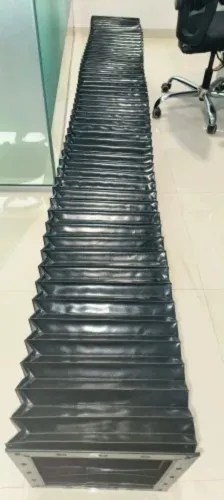
Leave the guideway and ball screw installed, isolate machine power, and move the axis by hand only after securing it against unexpected travel. For a replacement custom CNC machine bellows, photograph the cover fully compressed, fully extended, and at an intermediate position.
1. Measure the installed compressed and extended lengths along the axis. Count every fold and record the fold pitch.
2. Measure cover width, compressed height, extended height, flange length, and end-frame thickness. Measure the distance from each frame to the nearest moving machine part.
3. Record the fixed-end and moving-end attachment: frame plate, angle bracket, studs, eyelets, screws, clips, or sewn flange. Note which end uses each fitting.
4. Make a hole-location sketch from two fixed reference edges. Mark every hole centre, slot length, hole diameter, and fastener direction; do not rely on a photograph.
5. At both ends of travel, measure clearance above, below, and beside the cover. Include the carriage, cable carrier, ball screw, and adjacent sheet metal.
Do not pull a worn bellows to estimate travel; stretching it can reproduce incorrect geometry. Check the machine axis travel separately from the sample. Send these dimensions to a CNC bellow cover supplier in Coimbatore as inspection data, not proof that the original cover was correctly designed.
Include all photographs, the sketch, and any interference marks in the enquiry.
Fabric Bellows or Steel Telescopic Cover: Which Fits the Axis?
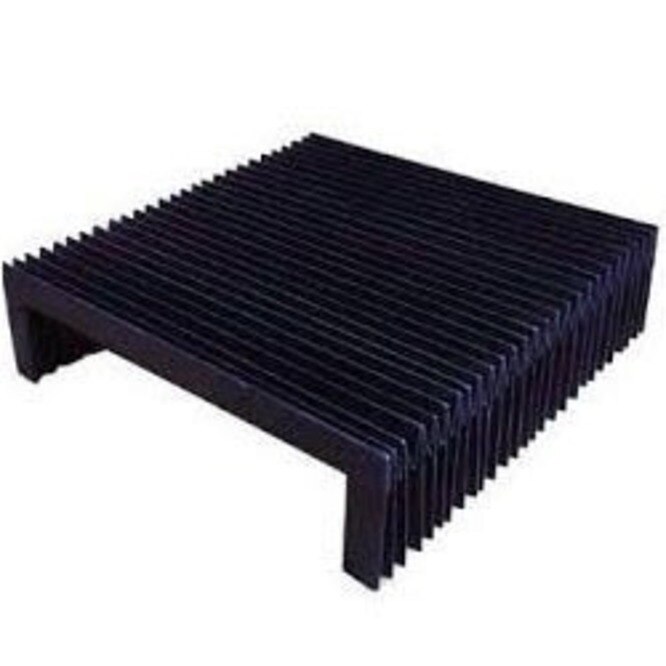
Choose fabric when the axis needs a flexible contamination barrier, low mass, shaped folds, tight routing, or limited installation space. Choose steel when heavy chips or impact demand a rigid shield.
| Option | Best match | Space and trade-off |
|---|---|---|
| Fabric bellows | Chips, coolant, dust, oil, and flexible routing | Shorter folded package and lower mass; not automatically load-bearing |
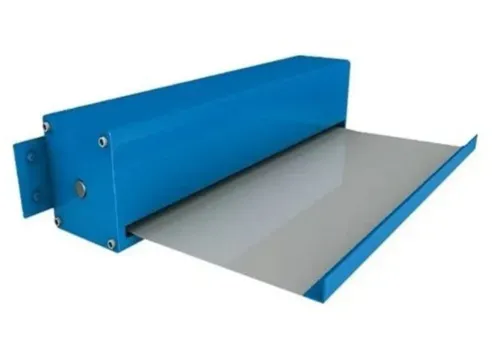
| Steel telescopic cover | Severe chip loads, direct impact, and rigid protection | Needs nesting depth, accurate alignment, guides, drainage, and maintenance access |
| Hybrid cover | Fabric sealing with a slat, apron, or steel shield | Adds protection but requires clearance and motion checks for both components |
PU-coated fabric is a common balance for chips, coolant, and abrasion. PVC-coated fabric fits only when its documented chemical and temperature limits match the coolant; neoprene-coated fabric suits oil exposure and repeated flexing when the specified construction supports it.
Do not select aramid, PTFE-coated, silicone-coated, or other heat-resistant fabrics from appearance. Obtain written confirmation for chip temperature, sparks, nearby heat sources, abrasion, cleaning method, and warranty conditions. A fabric cover alone is unsuitable for welding spatter, falling tools, heavy hot chips, or direct impact.
For a CNC guideway bellow cover in Coimbatore, compare installation depth, compressed length, weight, noise, drainage, maintenance access, and interference throughout the stroke. Kalavijay Engineering is one manufacturer to ask for the drawing, material construction, and full-stroke clearance confirmation rather than relying on a sample’s appearance.
Related products
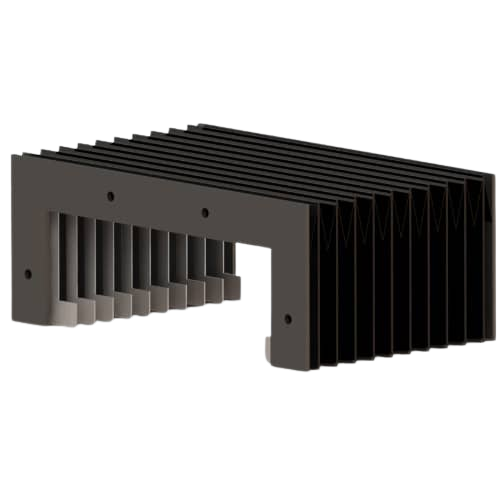 | Bellow Cover Some machines like the 5 axis grinding machine in the tool manufacturing industry require protection of the rails and ball screws from hundreds of... View product → |
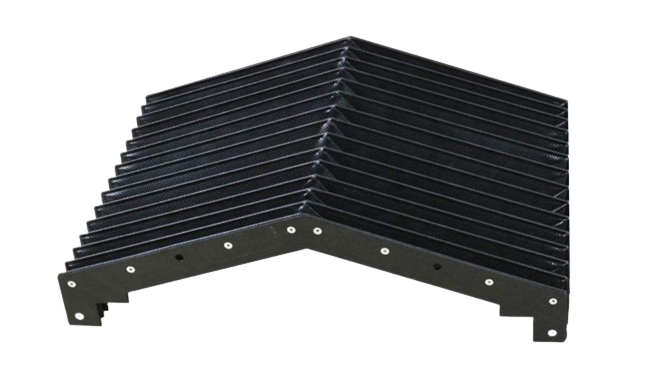 | Bellow Cover We are considered a well-known name in the business that manufactures and supplies CNC Bellow Cover. View product → |
How Custom Bellows Are Designed and Their Limits Confirmed
A custom CNC machine bellows design is acceptable only after the supplier proves that its geometry, attachments, and service limits match your machine.
1. Calculate fold spacing against axis travel, compressed length, fold count, turning points, sag, ballooning, internal reinforcement, support strips, wipers, drain paths, and clearance from every moving part. Tighter folds save folded length but increase rubbing, restrict movement, and reduce usable travel per fold.
2. Confirm whether the cover runs horizontally, vertically, or upside down. Speed claims depend on orientation, support, and end fittings. Request a drawing identifying the fixed end, moving end, minimum clearances, fold count, mounting method, and internal guides.
3. Require written limits for coolant, oil, chip size, abrasion, temperature, sparks, washdown pressure, travel speed, acceleration, and cycle frequency. The supplier must state the construction and test or application conditions behind each limit; “custom CNC machine bellows” proves none of these resistances.
4. Inspect end frames, stitching, eyelets, strain relief, and sharp edges. Attachment failure can tear the cover before the fabric fails.
Put these items on the purchase order:
- Material and coating
- Cleaning method and permitted chemicals
- Required full-stroke motion check
- Inspection dimensions for extended and compressed lengths
- Warranty conditions covering the stated service limits
A CNC bellow cover supplier in Coimbatore should provide this evidence before production, not after installation. Ask the supplier to record the approved drawing revision and retain the test or application conditions with the quotation.
Frequently asked questions
How do I find and screen a CNC bellow cover supplier in Coimbatore?
Search machine-tool service firms, industrial fabricators, and manufacturer websites. Ask whether the supplier can modify fold geometry, fabricate end frames, and inspect parts from a dimensioned drawing or physical sample.
What should I send with a request for quotation for custom CNC machine bellows?
Send axis travel, compressed and extended lengths, folded height, width, mounting details, material requirements, machine photographs, coolant and chip conditions, operating speed, and temperature exposure.
How can I measure an existing CNC guideway bellow cover without removing it?
Record the exposed travel, overall width and height, compressed length, extension length, mounting-frame dimensions, screw positions, clearance to moving parts, and the direction of motion. Photograph both ends and the folded section.
Should I choose fabric bellows or a steel telescopic cover?
Choose fabric bellows when flexibility, low mass, and protection from dust, coolant, oil, or light chips are priorities. Choose a steel telescopic cover for heavy hot chips, impact, and rigid guideway protection.
How are custom CNC bellows designed and their limits confirmed?
The fabricator matches travel and folded height to the fold geometry, selects fabric and reinforcement for the exposure, designs mounting frames, checks clearances, and confirms speed, temperature, stroke, and service limits before production.