
Buying the right cover starts with the fluid, temperature, machine travel and mounting arrangement—not the words “oil proof” or the colour black. You will be able to prepare a complete enquiry, compare local suppliers, check the proposed construction and approve a cover that fits the machine before ordering.
Key takeaways
- Send axis travel, closed and extended lengths, width, height and mounting details.
- Name the actual fluid, temperature, chips and exposure—not only “oil proof.”
- Ask for material, seam, fold and mounting details before comparing quotations.
- Inspect travel, compression, seals and mounting fit on the first cover.
How to find and brief a Coimbatore bellow-cover supplier
Give a supplier the machine axis, duty, fluid and exposure before asking for a price. Search for an oil proof black bellow cover in Coimbatore using terms such as “machine-tool way cover,” “custom dimensions,” the axis travel and the fluid name, not just a colour or location.
1. Tell the black bellow cover supplier in Coimbatore whether the cover faces neat cutting oil, soluble coolant, hydraulic oil, way lubricant or solvent-based cleaner. Ask for a written compatibility statement for that named fluid, plus the base fabric, coating or elastomer grade, seam method, reinforcement and continuous and peak temperature range.
2. Send extended length, compressed length, usable travel, inside and outside dimensions, fold height, number of folds, mounting-hole pattern and the required open and closed clearances. Overall length alone can produce a cover that bottoms out, stretches or strikes the machine.
3. Describe hot chips, abrasive swarf, grinding dust, welding sparks, direct oil immersion and wash-down chemicals. A cover rated for oil splash can fail when chips lodge in folds or hot swarf cuts the fabric.
4. Request a dimensioned drawing for approval before manufacture. Ask for a sample or first article, then move it by hand through the full stroke; check that folds open uniformly, do not rub or invert, and contain no trapped reinforcement.
5. Confirm local inspection, delivery to your site and the contact handling drawing revisions before you authorise multiple covers.
What “oil proof” must mean for your machine
“Oil proof” means compatible with your machine’s named fluid at its actual operating temperature, not simply a black colour or a supplier’s label. Identify whether the cover will contact neat cutting oil, soluble coolant, hydraulic oil, way lubricant, grease, diesel or a solvent-based cleaner; mixtures can behave differently from their individual ingredients.
For an oil resistant bellow cover, request these details in writing:
- Base fabric and coating or elastomer grade, such as nitrile, neoprene or polyurethane
- Compatibility statement or fluid-resistance chart for your exact fluid
- Continuous and peak temperature limits, plus the lowest temperature at which the cover remains flexible
- Seam method and reinforcement material
- Material data sheet and any flex-fatigue or exposure test information
“Rubberized fabric” and “synthetic leather” do not identify resistance or service life. Reject a quotation that only says “oil proof bellow cover in Coimbatore” without naming the construction and limits.
Verify the first article against the drawing before ordering several covers. Check the proposed compressed length against the machine’s available clearance at both ends of travel; forcing the bellows into a shorter pack creates creases, rubbing and cracks.
Move the cover through the complete stroke by hand, checking that every fold opens evenly, does not invert or rub, and leaves no trapped reinforcement. A sample exposed to the named fluid at the stated temperature provides stronger evidence than a generic product claim.
Measurements to send for an accurate quotation
Send the machine axis, usable travel and fluid name with the drawing request; “oil proof black bellow cover in Coimbatore” is not enough for a buildable quotation. State whether the axis is horizontal or vertical, the travel speed, acceleration, cycle frequency and the lowest and highest operating temperatures.
- Extended length and compressed length
- Usable travel, measured between the fully open and fully closed positions
- Outside width and height, plus the protected inside opening
- Fold count and fold height
- Open and closed clearances around the cover
- Mounting-hole pattern, flange dimensions and fixing direction
- Guideway, screw or cable position, including any projecting bolts or brackets
- Neat cutting oil, soluble coolant, hydraulic oil, way lubricant or cleaning solvent in contact with the cover
Show the operating positions rather than sending only an overall length. The supplier must compare the proposed pack length with available end clearance; force it into a shorter space and the folds will crease, rub or crack.
| Operating condition | Send this measurement | What it prevents |
|---|---|---|
| Fully extended | Overall length and usable travel | Stretching and pulled seams |
| Fully compressed | Pack length and end clearance | Bottoming out and fold inversion |
| Cross-section | Outside dimensions and inside opening | Rubbing against guides or restricting movement |
Also request the base fabric, coating or elastomer grade, seam method, reinforcement material and temperature range in writing. Ask for a drawing approval before manufacture, then check a first article by moving it through the complete stroke: every fold must open evenly, without rubbing, trapped reinforcement or collapse.
This gives any oil proof bellow cover in Coimbatore a defined fit rather than an estimate based on length alone.
Choosing the right construction for oil, chips and limited space
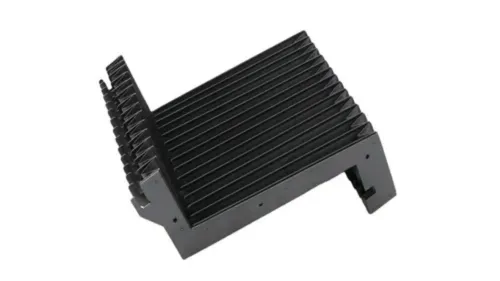
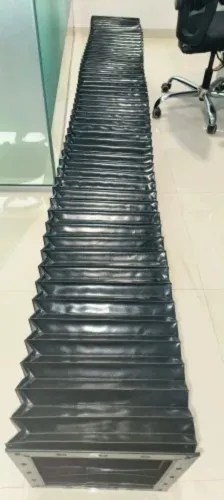
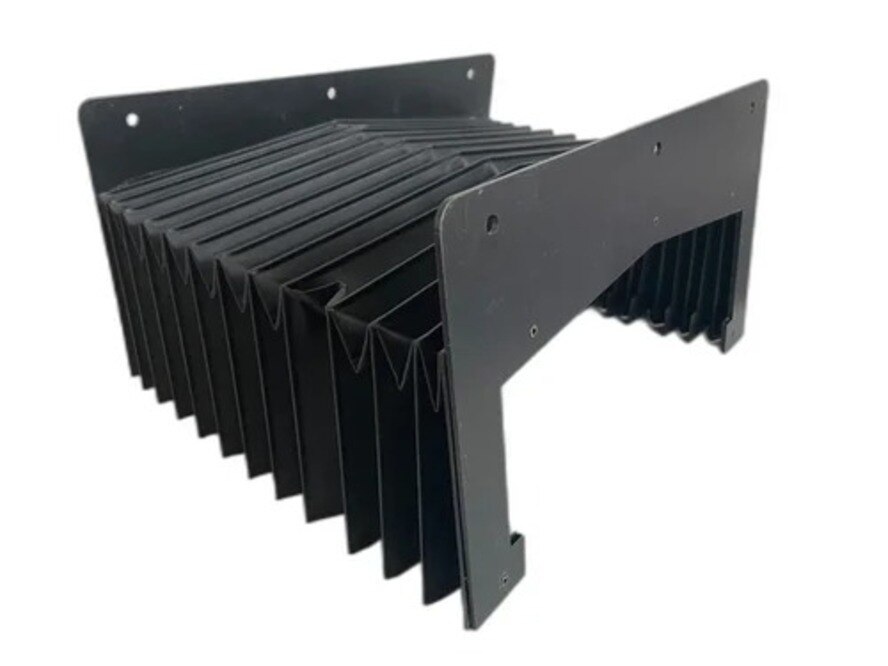
Choose a bellows cover when the axis needs continuous flexible protection in a tight envelope, especially against chips, oil and coolant. It folds into a short compressed length, follows horizontal or vertical travel, and avoids the side clearance required by rigid telescopic sections.
An oil resistant bellow cover is not automatically the best choice for heavy hot chips or severe impact.
| Option | Best fit | Main limitation |
|---|---|---|
| Bellows cover | Limited space, repeated travel, chips and fluid splash | Can fail if folds rub, invert or bottom out |
| Telescopic steel cover | Heavy chips, impact and high cutting heat | Needs more space, guides and maintenance |
| Sewn leather cover | Low-speed protection and moderate abrasion | Leather and stitching can degrade in oil and coolant |
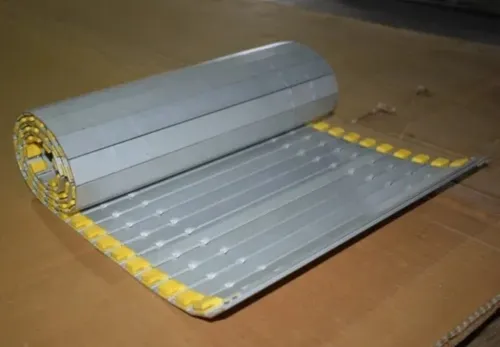
| Roller blind | Long travel with very small folded volume | Less suitable for sharp chips, impact and complex paths |
| Rubber boot | Short stroke, sealed joints or rods | Poor choice for long travel and frequent folding |
Service life depends on more than black colour. Specify the base fabric, coating or elastomer grade, seam method, reinforcement, fold height and temperature range; name the actual fluid, such as hydraulic oil or soluble coolant.
For an oil proof bellow cover in coimbatore, request these details in writing, then approve a drawing and inspect a first article. Move it through the full stroke and check uniform opening, clear folds, secure mounts and no trapped reinforcement.
How to place the order and inspect the first cover
Place the order only after the supplier returns an approved drawing and a clear first-article plan. In your enquiry to Kalavijay Engineering, identify the machine axis, usable travel, fluid, and “custom dimensions” rather than asking for a generic oil proof black bellow cover in Coimbatore.
- Request a dimensioned drawing showing extended and compressed lengths, outside and inside dimensions, fold height and count, open and closed clearances, flange width, corner treatment, and mounting-hole pattern.
- Ask for the base fabric, coating or elastomer grade, reinforcement material, seam method, temperature range, and a compatibility statement for your named fluid. “Rubberized fabric” alone is not a specification.
- Confirm the delivery arrangement in writing: dispatch date, packing method, transport responsibility, delivery address, installation support, and whether you can inspect locally before acceptance.
- Require one sample or first article before ordering replacements or multiple covers. Record its drawing number and revision so later pieces match the approved design.
During inspection, fit the cover without oil first. Move the axis by hand through the complete stroke; check that every fold opens uniformly, no fold rubs or inverts, reinforcement is not trapped, and the cover neither bottoms out nor stretches at full travel.
Inspect the flange, screw heads, stitched edges, and corners for gaps or unsupported areas. A black bellow cover supplier in Coimbatore that cannot document these points has not supplied a production-ready cover.
Related product
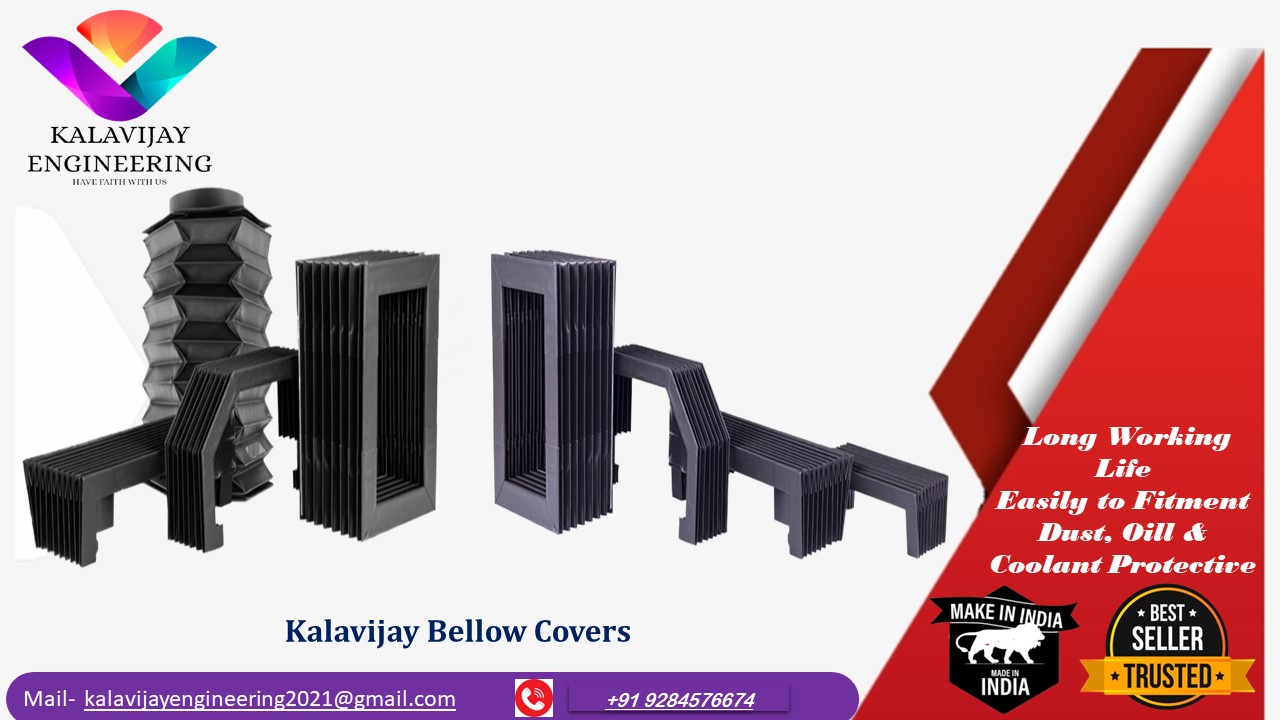 | Bellow Cover We, " KALAVIJAY ENGINEERING" are masters in manufacturing and supplying excellent quality of Bellows covers. View product → |
Frequently asked questions
How do I brief a Coimbatore bellow-cover supplier?
State the machine axis, travel, duty cycle, fluid name, temperature, chips, sparks, available space and mounting method. Search for machine-tool way covers and custom dimensions rather than colour alone.
What should “oil proof” mean for my machine?
Identify the exact coolant, cutting oil, hydraulic oil or lubricant and its operating temperature. Ask the supplier to confirm material and seam compatibility with that fluid, plus resistance to chips, abrasion and cleaning chemicals.
What measurements are needed for an accurate quotation?
Send axis travel, closed length, extended length, compressed height, expanded height, width, fold pitch, mounting-hole pattern, flange dimensions and clearance around the moving axis. Include photographs and a simple dimensioned sketch.
Which bellow-cover construction suits oil, chips and limited space?
Compare coated fabric, stitched or welded seams, internal support, fold geometry, scrapers and guide arrangements. Choose the construction that protects against the actual chips and fluid while fitting the available compressed space.
How should I inspect the first cover before approving the order?
Check the material and seams, unfold and compress the cover through its full travel, verify mounting holes and clearances, and look for rubbing, trapped folds, gaps or coolant paths. Record corrections before releasing repeat quantities.