
A drag chain that fits a cable bundle can still fail through corrosion, excessive unsupported load, tight bending, chip ingress or poor cable separation. By comparing steel and reinforced nylon, calculating usable internal space, and checking travel geometry and operating loads, you can specify a carrier that suits the machine rather than choosing by nominal width alone.
Key takeaways
- Choose steel for sparks, hot chips and foundry scale.
- Choose stainless steel for corrosive coolant, humidity and outdoor exposure.
- Size internal space for cables, separation, motion and bend radius.
- Compare quoted price with installation, replacement and delivery costs.
Steel, stainless steel or reinforced nylon: which material suits the machine?
Reinforced nylon suits clean, lightweight, quiet axes; steel suits welding sparks, hot chips and foundry scale; stainless steel suits corrosive coolant, humidity and outdoor exposure. Select the chain for the hazard, not the material label alone.
| Material | Strengths | Limits and best fit |
|---|---|---|
| Reinforced nylon | Light, quiet, flexible and usually lower-cost; resists many coolants and humidity | Hot sparks, sharp swarf, radiant foundry heat and high impact can damage it; use inside clean enclosures |
| Painted or zinc-plated steel | Highest impact resistance, good heat tolerance and strong unsupported capacity | Heavier, noisier and vulnerable to rust after coating damage; use around chips, sparks and heavy hoses |
| Stainless steel | Strong, corrosion-resistant and suitable for washdown, humidity and outdoor service | Heavier and costlier; sliding pins, bushes, rollers and contaminated crevices still wear |
A metal cable drag chain comparison in Surat must state coolant chemistry, cleaning agents, washdown frequency, chip temperature, abrasive dust, enclosure status and outdoor exposure. For chloride-bearing conditions, compare AISI 304/1.4301 with AISI 316/1.4401; 316 contains molybdenum and generally resists chlorides better, but “stainless” alone proves nothing.
A stainless steel cable drag chain comparison should also include surface finish, fastener material and maintenance access. Open links are a poor choice where hot chips or abrasive swarf can enter: choose covered links, chip-resistant covers, wipers or a guide trough before assuming stainless steel solves the problem.
Alignment and contamination can shorten any chain’s life.
Match the chain to speed, temperature, travel and unsupported load
A chain can fit the cables and still fail in service. Select it against speed, acceleration, travel, unsupported span, moving cable-and-hose weight per metre, operating temperature and the largest cable or hose bend radius.
| Arrangement | Specify | Failure risk |
|---|---|---|
| Horizontal sliding | Unsupported length, load per metre, speed and acceleration | Sagging, buckling or excessive wear |
| Vertical loop | Orientation-specific load, mounting and loop geometry | Chain collapse or bracket overload |
| Side-mounted | Lateral load, side clearance and allowable travel | Twisting, rubbing or link separation |
| Rotary or suspended | Rotary radius, torque, suspension load and manufacturer approval | Binding, uncontrolled swing or fatigue |
For long horizontal travel, unsupported length often limits performance before nominal chain load does. As travel, mass, speed or acceleration rises, choose a guide trough, roller-supported design or roller chain instead of a standard sliding chain.
Request these figures for every industrial cable drag chain options comparison:
- Maximum and continuous speed, acceleration and cycle frequency
- Chain operating temperature against peak chip, coolant and ambient temperature
- Total moving mass per metre, including cables, hoses and separators
- Unsupported span, total travel, mounting orientation and support method
- Cable and hose minimum bend radius; set the chain radius equal to or greater than the largest permitted value
Also state coolant, cleaning chemicals, washdown, abrasive dust, outdoor exposure and enclosure location. “Stainless” does not define chemical resistance without the grade and actual exposure. A chain rated for one orientation is not automatically suitable for another.
Calculate usable internal height, width and bend radius
Do not size from the chain’s nominal outside width. Use the supplier’s sectional drawing to identify usable internal height and width, then fit the actual cable and hose outside diameters inside those limits.
- Measure each cable and hose at its largest point, including moulded plugs, corrugation and protective sleeves.
- Set internal height above the largest diameter, with clearance for movement. If you stack items vertically, add every diameter, gap and divider thickness; avoid stacking unless the carrier maker approves it.
- Set internal width as the sum of side-by-side diameters, movement clearances and separator thicknesses. Separate heavy hoses and power cables from small signal cables so they cannot crush, cross or abrade one another.
- Choose the bend radius from the largest cable or hose manufacturer’s permitted minimum radius. The carrier radius must equal or exceed that value; a tighter chain will damage conductors, shielding or hose reinforcement.
- Check the resulting cable-and-hose weight per metre against the chain’s unsupported-load rating, not just its physical capacity. A carrier that fits can still sag, overload its links or fail under acceleration.
Leave spare space for installation tolerances, thermal expansion and cable movement, but do not treat empty volume as a substitute for separators. For a metal cable drag chain in Surat, request the sectional drawing showing clear dimensions, divider layout and bend radius, then verify those figures against the machine’s stroke, mounting orientation and support arrangement.
Insist on measured dimensions rather than “nominal width” alone.
Check travel geometry and arrange cables for long service life
Start with the machine’s actual coordinates, not the chain’s nominal length. Record the stroke, fixed-end position, moving-end position, mounting height, travel direction and available clearance at both ends. Give these dimensions to the manufacturer and request a layout drawing showing the chain’s complete bend radius, end brackets and required chain length.
Verify the application orientation before approving the chain. Horizontal unsupported travel, horizontal travel in a guide trough, vertical lifting, side-mounted travel and rotary movement impose different loads. A chain rated for a horizontal unsupported span is not automatically suitable for a vertical loop or suspended installation.
Use this checklist against the machine drawing:
- Confirm the required stroke and the chain’s usable travel after allowing for fixed and moving end connections.
- Check the chain’s maximum unsupported length against cable-and-hose weight per metre, speed and acceleration. If the loop sags, buckles or rubs, specify a guide trough, rollers or a roller-supported design.
- Verify the installed bend radius and the clearance below the loop, above the machine bed and around nearby guards.
- Request orientation-specific load, mounting and installation-height data for side-mounted, vertical or rotary arrangements.
- Separate heavy hoses and power cables from small signal cables with partitions. Do not cross, twist or stack cables so tightly that they cannot move during bending.
- Provide clearance around every cable and hose for movement, not just its static diameter.
- Fit strain relief at both fixed and moving ends. Clamp firmly without crushing a hose or deforming a cable jacket; never transfer pulling force through the links or connector.
Build a comparable purchase specification and delivered-cost calculation
Request a machine cable drag chain supplier in Surat to quote a complete, installable system, not a chain body priced by metre. Require a sectional drawing showing the installed orientation, and a bill of materials that identifies every supplied component.
- Chain series, material, surface finish, inside height and width, bend radius, link pitch, and total length
- Separators, cable shelves, end brackets, fixed and moving mounting plates, and strain-relief clamps
- Guide trough, rollers, or other support for the stated travel and unsupported length
- Permitted cable and hose diameters, total carried mass, speed, acceleration, temperature range, and washdown conditions
- Replacement links, joining hardware, spare separators, and recommended installation tools
- Cable routing instructions that prevent jacket-to-jacket contact, crushing, and pull at both connectors
State the actual environment: coolant type, cleaning chemicals, chip temperature, abrasive dust, welding sparks, outdoor exposure, and enclosure status. “Stainless steel” is incomplete without grade and finish; corrosion also depends on crevices, contamination, and chemical contact. Confirm that the carrier bend radius equals or exceeds the largest cable or hose manufacturer’s permitted minimum.
Compare delivered installed cost, not the catalogue price. Use: chain body + accessories + trough or supports + freight and taxes + installation labour + replacement parts. A shorter-radius chain can enlarge the machine envelope, while an unpriced trough or rapid chip damage can erase the initial saving.
Whether you approach Kalavijay Engineering or another supplier, issue this same specification so quotations remain comparable.
Related product
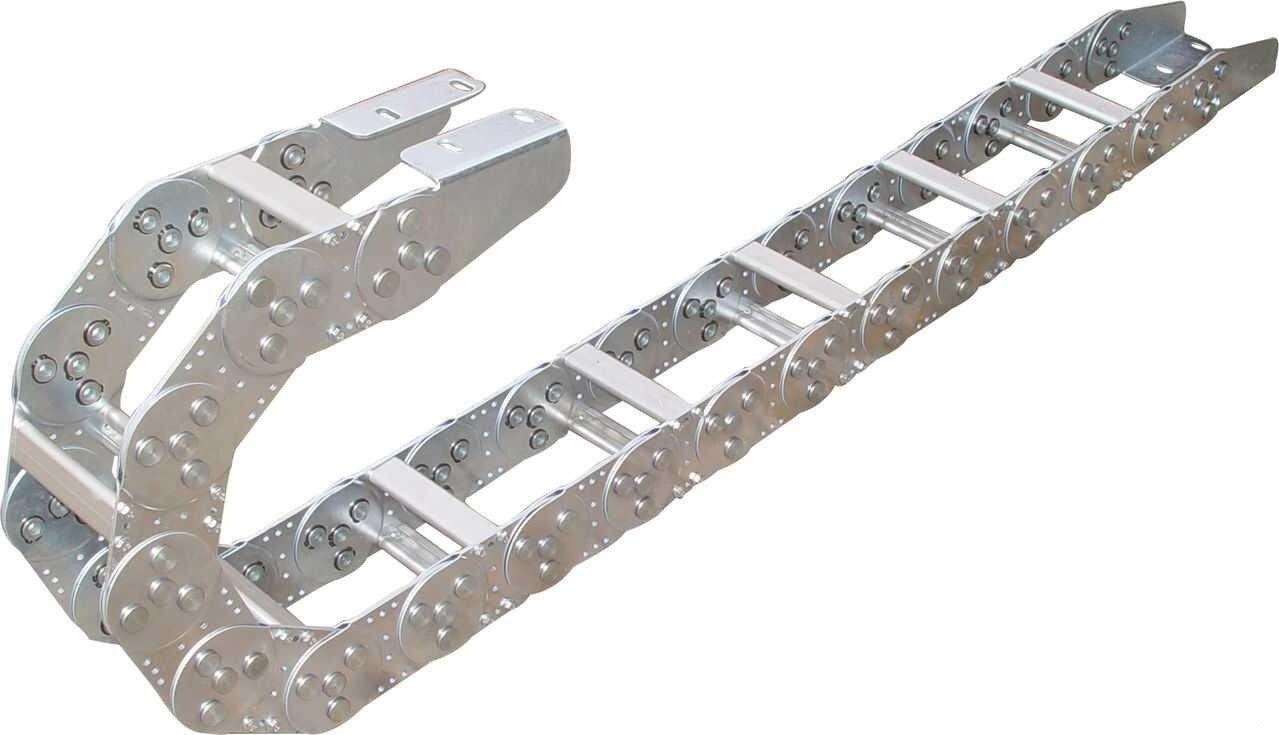
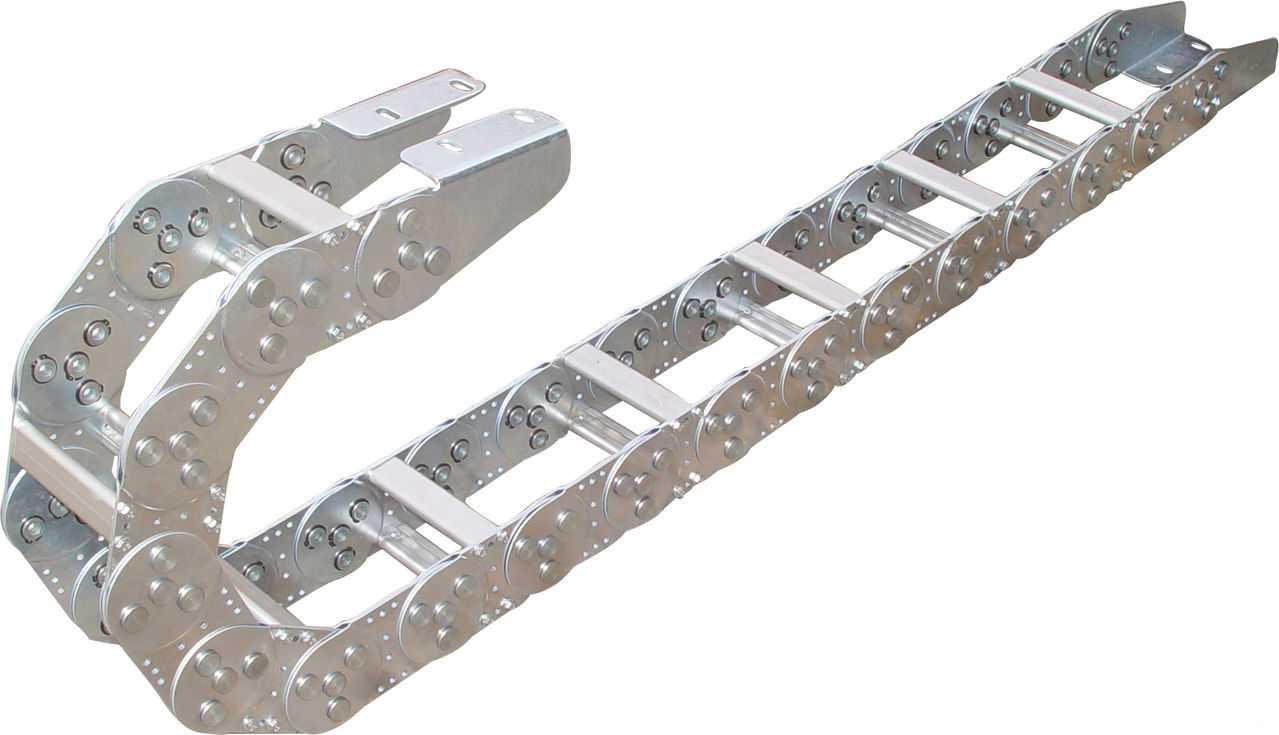 | Metal Cable Drag Chain We are offering Stainless Steel Cable Drag Chains used for steel industries, foundries and metal treatments. View product → |
Frequently asked questions
Which drag chain material suits a machine in Surat?
Use reinforced nylon for clean, lightweight and quiet axes. Use steel near welding sparks, hot chips and foundry scale. Use stainless steel where corrosive coolant, humidity or outdoor exposure threatens ordinary steel.
How do you match a cable drag chain to machine movement?
Check the chain’s rated speed, operating temperature, unsupported length, travel distance and allowable load. Reject a chain when the moving cable bundle exceeds its load rating or the axis exceeds its speed or temperature limit.
How do you calculate the required internal height and width?
Measure the cable bundle’s outside dimensions, then add clearance for movement and separators. Choose internal height above the tallest cable and internal width above the bundle width, while keeping each cable within the maker’s bend-radius limit.
How should cables be arranged inside a drag chain?
Keep cables separated by diameter and function, prevent crossing, and leave room for movement. Support the cable at both ends, avoid tight clamping at the moving link, and confirm the chain’s bend radius exceeds the cable’s minimum bend radius.
What should a comparable drag-chain quotation include?
Request material, internal height and width, bend radius, chain length, end connectors, separators, speed rating, temperature range, unsupported length, delivery terms, taxes, freight and installation items. Compare the delivered total rather than the chain price alone.