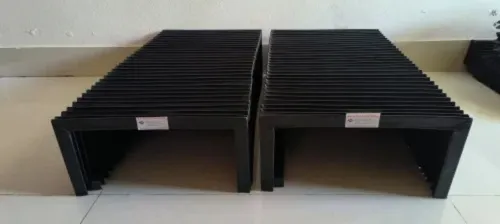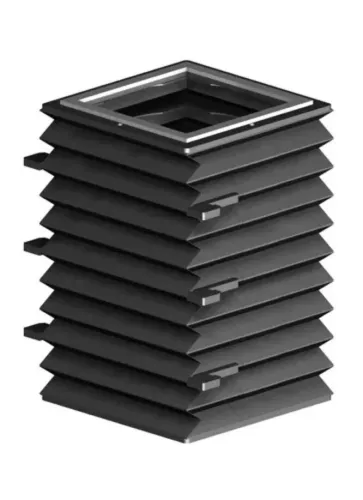

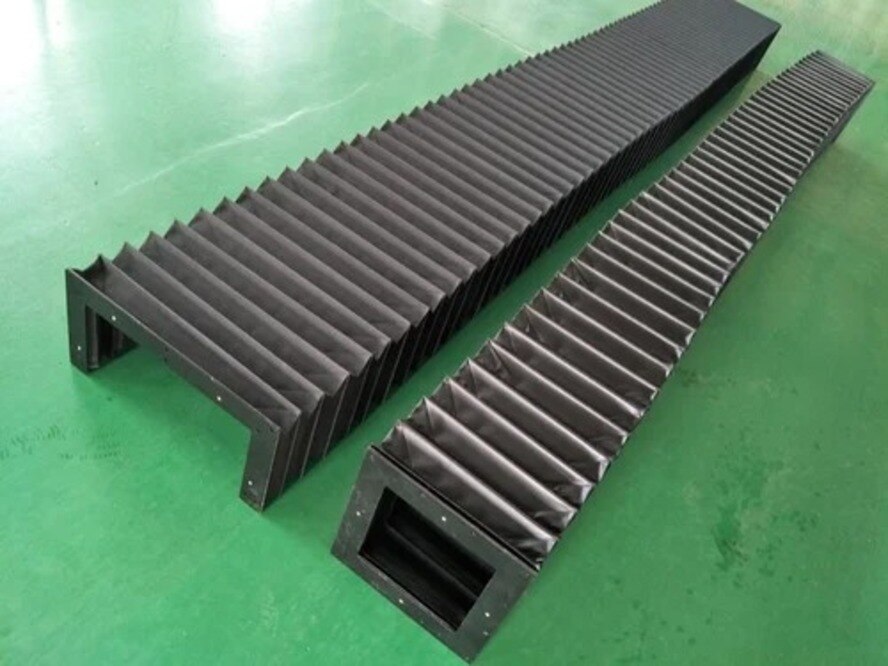
A marble cutter needs protection when abrasive dust, water, slurry or chips can reach its guideways, screws, sensors or other moving mechanisms. By checking the machine’s exposure, movement, existing enclosure and cleaning method, you can decide whether a bellow is essential, advisable or the wrong solution—and specify a replacement that does not restrict travel.
Key takeaways
- Protect exposed guideways when dust, slurry or chips can reach moving components.
- Use sealed, abrasion-resistant bellows for wet slurry and sharp stone chips.
- Measure full travel, folds and mounting clearance before ordering a cover.
- Inspect folds, seams and fasteners regularly; replace covers before debris reaches the way.
When Is a Bellow Cover Essential on a Marble Cutter?
A marble cutting machine bellow cover is essential when stone dust, wet slurry, spray or chips can reach an exposed guideway, ball screw, rack, bearing, linear encoder, hydraulic cylinder, motor or cable carrier. The decision belongs in the machine risk assessment, not in the machine name alone.
Use a bellow as part of marble cutting machine protection when:
- Cutting discharge reaches a moving mechanism during dry or wet operation.
- Cleaning spray drives contamination into guideways, screws, sensors or cable carriers.
- Partial guarding blocks large debris but leaves gaps for dust, slurry or spray.
- A flexible cover is the only practical way to protect an irregular mechanism in limited installation space.
An open design may not justify a bellow when the factory enclosure fully blocks the discharge stream, drains water away from the mechanism and leaves no vulnerable part exposed. Verify that condition during cutting and cleaning, not only with the machine stopped.
A bellow controls contamination; it does not replace a fixed or interlocked guard around a blade, carriage or pinch point. Large falling stone pieces need rigid shielding, while poor drainage can trap abrasive slurry inside folds. Restricted cleaning access creates another failure.
A rigid splash shield combined with a flexible seal can protect the cutting zone better than one bellow alone.
How Do Dry Dust and Wet Slurry Damage Machine Components?
Dry cutting creates abrasive marble dust that enters rail blocks, screw nuts, rack teeth, bearings, motor-cooling paths and sensor housings. The particles increase friction, wear sealing lips and raise axis load. A marble machine bellow cover must exclude dust and resist abrasion, not merely look flexible.
Wet cutting changes the failure path. Water carries fine mineral particles into folds, end gaps, wipers and guideway interfaces, where slurry continues abrading surfaces after cutting stops. Water corrodes unprotected fasteners and electrical connections; coolant additives and cleaning chemicals can attack coatings, adhesives and seams.
Polishing residue forms a fine paste that is difficult to remove from folds. Coarse chips can puncture fabric, damage wipers or strike a cover beside the blade.
| Condition | Main damage | Protection requirement |
|---|---|---|
| Dry dust | Friction, sealing-lip wear and higher axis load | Particle exclusion and abrasion resistance |
| Wet slurry | Abrasion inside folds, gaps and guideway interfaces | Sealed ends, overlap, splash shielding and drainage away from the rail |
| Chips and spray | Punctures, wiper damage and impact | Sacrificial shield or wear strip beside the blade |
Specify the actual slurry concentration, particle size, pH, temperature, coolant additives, cleaning chemicals and exposure frequency. Also state the axis cycle rate and cleaning method. Ask for tested manufacturer limits; “water-resistant” or “strong” does not prove suitability for continuous slurry contact or complete marble cutting machine protection.
Which Protection Design and Material Fits the Machine?
Choose protection around the mechanism and its motion, not the machine’s outside dimensions. Define the target: linear rail, ball screw, rack, hydraulic cylinder, cable carrier, spindle assembly, or cutting zone.
A marble machine bellow cover fits irregular geometry, broad coverage, and restricted installation space; a marble cutting machine bellow cover is not automatically right for a straight, impact-exposed axis.
| Option | Main advantage | Limitation or suitable use |
|---|---|---|
| Flexible bellow | Covers irregular paths and large areas in tight spaces | Needs protection from direct stone impact |
| Telescopic steel or stainless-steel cover | Tolerates heavy chips and direct strikes | Requires rigid mounting space and a straight travel path |
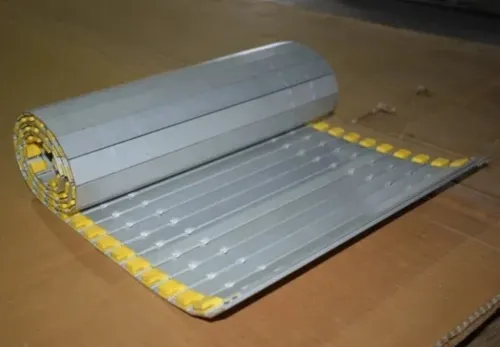
| Roller cover | Compact protection for a predictable linear path | Less suitable for complex movement or severe slurry |
| Wipers or brush seals | Scrape contamination from a surface or gap | Rarely provide complete protection alone |
| Curtains or splash shields | Deflect spray and falling debris | Need sealed edges and drainage to stop slurry migration |
| Exposed guideway | Lowest installation complexity | Acceptable only when enclosure fully blocks contamination |
Select PU-coated fabric only after verifying abrasion resistance, flex-cycle rating, temperature range, and chemical limits for the actual dry dust or moderate wet duty. Request PVC-coated fabric data when water, slurry, coolant, or cleaning agents dominate. Use stainless-steel lamellae or a rigid shield where coarse stone strikes the cover.
Specify seam construction, end-frame sealing, drainage, overlap, replaceable wear strips, splash shields, and sacrificial sections. Kalavijay Engineering can help compare a custom bellow with a rigid or hybrid design when you provide exposure and motion data.
Related product
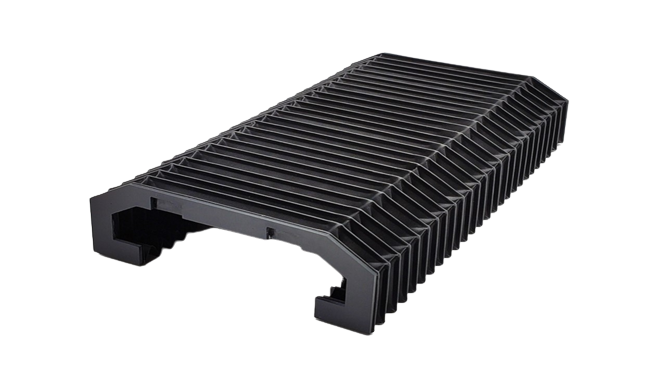 | Bellow Cover Marble Cutting Machine Bellow Cover We are offering a broad collection of Bellow Cover is used in a variety of machines to prevent dust particles, metallic chips and foreign particle. View product → |
What Measurements and Installation Details Prevent Interference?
1. Measure the existing marble cutting machine bellow cover fully extended and fully compressed. Record its width, height, folded height, number of folds, travel direction, minimum bend radius and attachment style. Measure the mounting-hole pattern, flat mounting surfaces, end-frame thickness and bolt-head clearance.
2. Map nearby interference points: the distance to the saw head, blade guard, cables and adjacent structures. Check clearance at full stroke, during acceleration and deceleration, and at maximum lateral movement.
If no cover exists, provide the machine make and model, axis travel, photos from both stroke ends, a side elevation, mounting-surface dimensions and expected duty cycle.
3. Require a replacement drawing showing closed length, extended length, stroke, cross-section, mounting-hole coordinates, fold pitch, attachment orientation, drainage direction and any required wiper or overlap. Decide whether the cover attaches to the moving carriage or machine frame, then confirm that folds cannot sag into the cutting path or rub during reversals.
These details support marble cutting machine protection without restricting axis travel.
4. Install under lockout/tagout with safe access to pinch points. Use aligned, flat brackets, clear fastener access and protected cable routing. Commission the marble cutting machine bellow cover through the full stroke at low speed before production resumes; check noise, rubbing, fold collapse, leakage, preserved cutting travel and accuracy.
A flexible cover does not replace blade, carriage or pinch-point guarding.
How Should You Maintain and Evaluate the Cost of Protection?
Set the inspection interval for a marble cutting machine bellow cover from slurry exposure and flex-cycle frequency, not from a calendar alone. Inspect more frequently under continuous wet cutting or high-cycle travel; never wait for a guideway fault.
- Torn or abraded folds, cracked or delaminated coating
- Failed stitching or welded seams
- Loose end frames or mounting bolts
- Damaged wipers
- Trapped slurry between folds
- Visible leakage behind the cover
- Rubbing, sagging or collapse into the travel path
Remove slurry only with the supplier’s approved method. Ask for permitted water pressure, spray direction, detergent or chemical limits, and the replacement procedure; do not fold, scrape or pressure-wash the cover in a way that drives abrasive material into seams.
Investigate stiff travel, unusual axis noise, rising motor load, fold abrasion, water leakage or visible slurry immediately. Recheck mounting bolts and alignment after commissioning and after abnormal impact.
Include these details in every quotation:
- Machine make and model, axis stroke, photos and drawings
- Wet or dry process, environment and cleaning method
- Cycle rate, service-life or flex-cycle target
- Required folded height and replacement access
| Cost factor | Bellow cover | Exposed mechanism |
|---|---|---|
| Purchase | Lower initial protection cost | Lowest initial cost |
| Maintenance | Cleaning and periodic replacement | Greater contamination exposure |
| Failure consequence | Planned downtime | Guideway or screw repair risk |
Factory design suits a new machine; retrofit during repair is sensible before contamination causes damage. This is practical marble cutting machine protection, not a substitute for a fixed guard. Do not delay replacement if the marble machine bellow cover blocks travel or threatens cutting accuracy.
Frequently asked questions
When is a bellow cover essential on a marble cutting machine?
Use a bellow cover when stone dust, wet slurry, spray or chips can reach an exposed guideway, ball screw, rack, bearing, encoder, hydraulic cylinder, motor or cable carrier.
How do dry dust and wet slurry damage marble cutting machines?
Dry dust enters bearings, screws and guideways as abrasive contamination. Wet slurry can carry fine stone particles into seals, harden as deposits and promote corrosion around moving and electrical components.
Which bellow cover design and material fits a marble cutter?
Choose the design from the travel path, available space, heat, coolant exposure and chip impact. Select fabric, coating and sealing details that resist abrasion, water, slurry and the machine's operating temperature.
What measurements prevent a marble machine bellow cover from interfering?
Record closed and extended lengths, guideway width and height, mounting points, fold height, stroke, bend direction and nearby clearance. Check the cover through the full machine travel before final installation.
How should you maintain and evaluate the cost of protection?
Remove accumulated dust and slurry, inspect folds and seams, check mounts and confirm unrestricted travel. Compare the cover's purchase and maintenance effort with downtime, cleaning and component-replacement costs.