
A damaged bellows cover is not automatically a replacement job, but closing a visible tear without correcting rubbing, heat exposure, or distorted supports invites repeat failure. You will be able to classify the damage, inspect and clean the cover safely, collect the measurements a repair provider needs, and choose between repair and a correctly matched replacement.
Key takeaways
- Repair flat-panel punctures when fabric, bonding, and attachments remain sound.
- Replace bellows when folds, frames, supports, or axis attachments lose their shape.
- Clean with a soft brush and approved cleaner; avoid compressed air into folds.
- Send photos, dimensions, stroke length, and damage details for an accurate quote.
When a Senfeng bellow cover can be repaired—and when it cannot
A small puncture in a flat outer panel is usually repairable if the surrounding fabric remains flexible, bonded, and firmly attached. A senfeng laser machine bellow cover for repair in kolkata needs replacement when damage affects the cover’s shape, support, or attachment to the axis.
| Condition | Repair decision | Why it matters |
|---|---|---|
| Small cut or hole in a flat panel | Repair | A compatible patch can restore the barrier when nearby folds and seams are sound. |
| Loose mounting hardware with an undamaged plate | Repair and refit | Correct fasteners can remove movement without rebuilding the cover. |
| Detached thermal weld or failed stitched seam | Inspect closely; replace if it has reopened | Repeated separation indicates that the material or joint has lost strength. |
| Torn fold, crushed bellows section, or coolant-soaked fabric | Replace | The cover may snag, leak contamination, or collapse during travel. |
| Bent end frame, distorted guide frame, or damaged internal support | Replace | Misalignment can overload the axis and expose guideways. |
| Exposed LM rail, rubbing through full travel, or multiple failed areas | Replace before operation | The machine has lost reliable protection and clearance. |
A credible laser machine bellow repair in Kolkata includes measurements, not only adhesive or stitching. Verify the exact machine model and axis, mounting-hole pitch, end-frame squareness, compressed height, extended length, fold clearance, and internal wear-strip position before refitting.
Do not treat a repaired cover as a missing fixed guard or interlocked enclosure. Assess openings and guarding against the machine hazard under ISO 14120; a cover that shields debris cannot replace a required safety guard.
A safe inspection and cleaning routine for Senfeng laser bellows
Begin only after the machine enters a documented safe state. Isolate electrical, pneumatic, and hydraulic energy, disable the laser source, wait through the specified discharge period, and prevent axis movement. The bellows do not make an energized axis safe; follow the machine risk assessment under ISO 12100.
1. Let hot slag and recently cut material cool. Remove the cover only when the axis cannot move and no stored energy remains.
2. Remove loose chips, slag, and dry metal dust with a vacuum or soft brush. Do not scrape the fabric, use high-pressure washing, or direct compressed air at folds, seams, guideways, or exposed LM rails.
3. Treat wet coolant residue with a clean cloth and a cleaner approved for the cover’s fabric, coating, and adhesive. Lift adhesive debris gently; never reach for an aggressive solvent that softens coatings or seam adhesive.
4. Dry the cover completely, then inspect every fold, stitched or welded seam, end frame, mounting plate, wear strip, and internal support. Look for torn fabric, detached thermal welds, crushed folds, distorted frames, loose hardware, and coolant penetration.
5. Move the protected axis through its full usable stroke under controlled conditions. Confirm that each fold opens and closes in sequence, the guide frame stays square, and the cover neither rubs nor pulls tight at extension or bunches at compression.
6. Record photographs, damaged locations, and any abnormal noise before applying machine-specific lubricant. This sequence makes senfeng laser bellow maintenance safer and gives a repair technician evidence instead of a guess.
How operating conditions determine inspection frequency and cover life
Inspect the cover at every shift start, then run a controlled full-stroke check at least weekly. For high-volume cutting, heavy slag, wet cutting, or abrasive dust, perform that travel check daily and repeat it after a collision, hot-slag strike, coolant leak, or abnormal axis load. Low-duty, clean cutting still needs weekly inspection.
During slow axis travel, check for these failure causes:
- A fold that fails to open or close in sequence points to crushed fabric, distorted supports, or an inverted fold.
- Rubbing against rails, sheet-metal edges, or the machine bed indicates misalignment, debris, a distorted guide frame, or insufficient clearance.
- A cover pulled tight at full extension indicates incorrect length, shifted mounting plates, or a travel stop problem.
- Bunching at compression indicates excess length, an obstruction, wrong fold geometry, or a damaged internal guide.
- Jerking, clicking, or abnormal axis load points to loose hardware, seized guides, detached thermal welds, or trapped slag.
- Tears, brittle coating, burn holes, and exposed seams show heat, sparks, abrasion, or chemical attack.
- Coolant or abrasive dust inside the folds signals failed seams and accelerates damage to the protected guideway.
Record the axis position where each symptom appears. Effective senfeng laser bellow maintenance includes removing the cause, not just wiping the cover; otherwise a replacement cover will fail along the same travel path. After cleaning, repeat the full-stroke test at low speed and confirm clearance from both sides before returning to production.
The measurements and evidence needed for an accurate repair quote
Brand name alone cannot identify the correct cover. For a Senfeng laser machine bellow cover for repair in Kolkata, send the exact machine model, axis and cover location, plus the original part number or nameplate photograph if available. Covers that look identical can differ in travel length, fold geometry and mounting frames.
Record these details before removal:
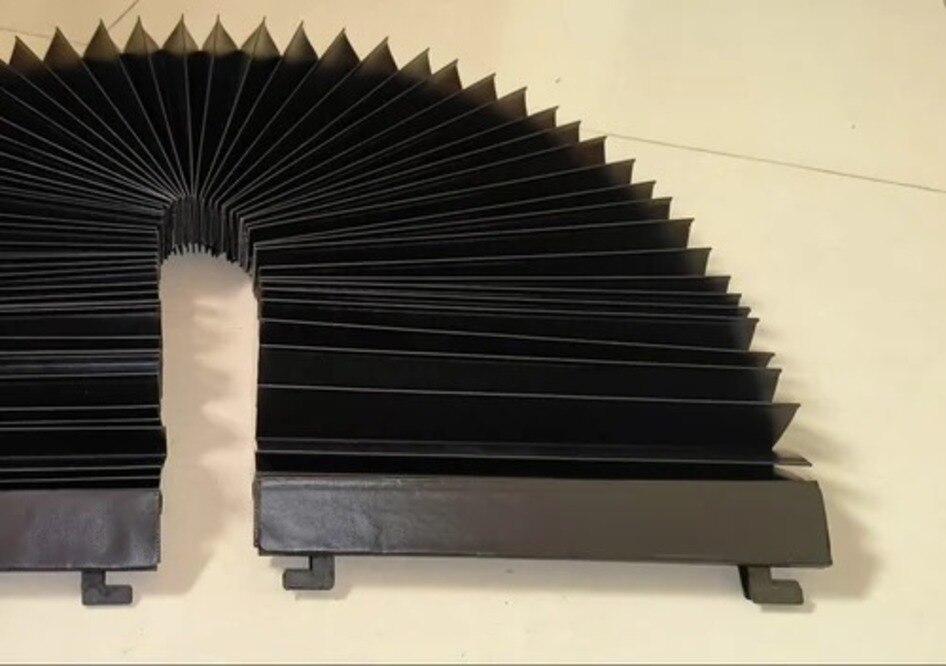
- Extended length and compressed height
- Fold pitch, fold height and total number of folds
- Cover width, end-frame length, height and squareness
- Mounting-hole pitch, hole diameter and mounting-strip position
- Travel direction, fold clearance and any interference during full-axis movement
- Positions of internal support frames, wear strips and guide hardware
- Photographs of every fold, both end frames, seams, mounting holes and the exposed LM rail
- The failure location: puncture, torn fabric, detached thermal weld, crushed fold, loose hardware, coolant penetration or distorted support
Photograph the cover installed and fully extended before removing it. Also state whether the machine cuts heavy slag, wet material or abrasive dust, because that affects material and reinforcement choices. Kalavijay Engineering can use this dimensional record to separate a local repair from a cover that needs fabrication.
A quote for laser machine bellow repair in Kolkata should state whether it includes reverse engineering, removal, refitting, end frames, internal supports and full-travel testing. Ask the provider to identify any guideway or alignment fault that caused the damage; otherwise a repaired cover may fail again.
Related product
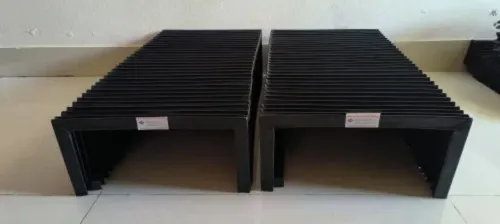
 | Bellow Cover Senfeng Laser Machine Bellow Cover Kalavijay has developed Senfeng Laser Machine Bellow Cover. This bellows type way cover fills the gap of Above the LM Rail. View product → |
Repair or Senfeng bellow replacement: making the final decision
Repair is economical when damage stays in a flat outer panel and the cover still holds its shape. A small puncture or local fabric separation can cost less to patch than to reproduce, provided the folds, seams, mounting strip, end frame, and internal supports remain sound.
| Option | Choose it when | Operational risk |
|---|---|---|
| Repair | Damage is local, the fold geometry is unchanged, and mounting hardware remains secure | A hidden seam or support defect can cause rapid failure after refitting |
| Complete replacement | A fold is torn or crushed, a frame is distorted, thermal welds have detached, or coolant has penetrated the cover | A poor match can restrict travel or overload the axis |
Do not approve a repair from photographs alone. The technician must check mounting-hole pitch, end-frame squareness, compressed height, extended length, fold clearance, and wear-strip position against the machine. Include removal, refitting, and correction of any rail misalignment or loose hardware that caused the damage.
Choose Senfeng bellow cover replacement when failure has reached a moving or load-bearing part, when the same seam has failed repeatedly, or when exposed rails leave no safety margin. After fitting, jog the axis slowly through its full stroke from both sides.
Reject the job if the cover inverts a fold, rubs a rail or sheet-metal edge, pulls at an end frame, creates abnormal load or noise, or lacks clearance at full compression and extension.
Frequently asked questions
When can a Senfeng laser machine bellow cover be repaired?
Repair a small puncture or tear in a flat outer panel when the surrounding fabric remains flexible, bonded, and firmly attached.
When does a Senfeng bellow cover need replacement?
Choose replacement when damage affects the cover’s shape, folds, support frames, mounting attachments, or movement along the axis.
How should you inspect and clean a Senfeng laser bellow cover?
Stop the machine, isolate power, inspect folds and attachments, remove debris with a soft brush or vacuum, and use only a cleaner approved for the cover material.
What information is needed for a Senfeng bellow repair quote?
Provide clear photos, cover dimensions, folded and extended lengths, mounting details, axis travel, material information, and the damage location.