
Chips, coolant and dust can reach the rail, carriage, recirculating balls and seals even when a machine appears clean from the outside. By the end, you will know how a bellow improves movement, which cover construction fits your hazards, how to measure a replacement and how to test it across the full stroke.
Key takeaways
- Keep chips and coolant out of the guideway bearing path.
- Match cover construction to heat, sparks, coolant and stroke length.
- Measure folded height, extended length, width and mounting points before replacement.
- Inspect folds, seals and fasteners, then test the full axis stroke.
How a Bellow Cover Keeps the Guideway Moving Cleanly
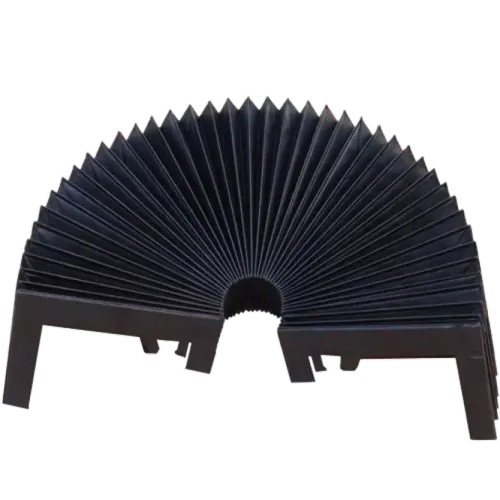
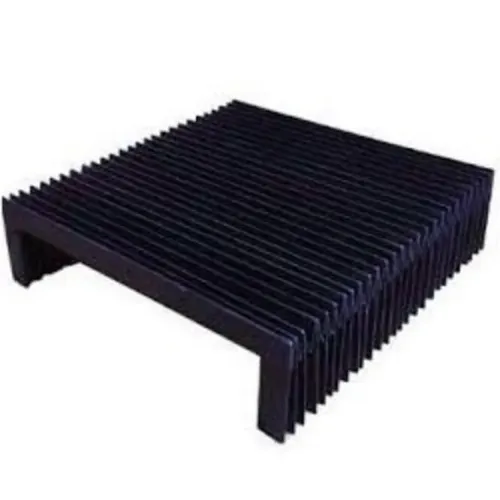
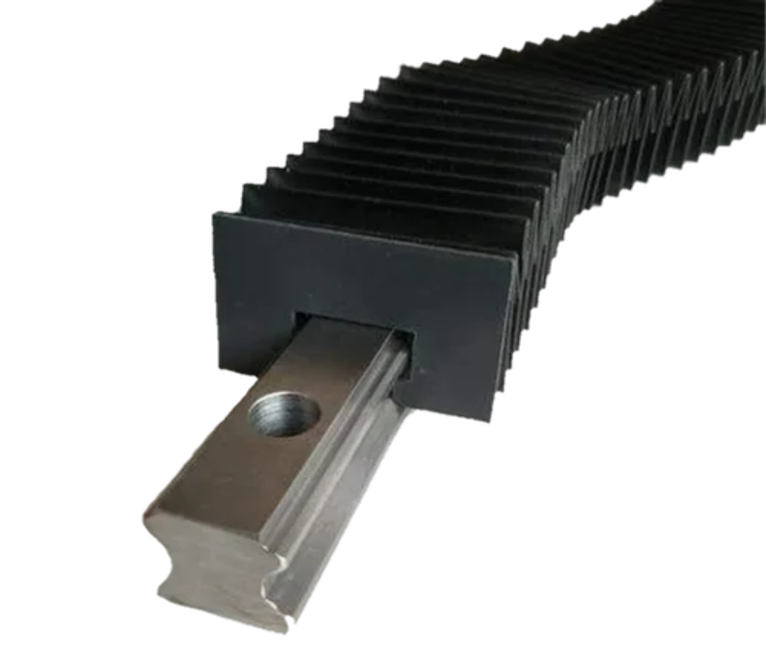
An LM guideway bellow cover keeps the rail clean by sealing the moving gap between the machine structure and travelling carriage. As the axis advances, its folded sections expand and contract with the motion, shielding the guideway from chips and coolant without entering the bearing path. It also limits airborne dust.
The cover prevents contamination from reaching the recirculating balls, raceways and carriage seals. A chip caught under a wiper can score the rail, cut a seal or combine with lubricant into abrasive paste. Hot chips can damage the cover or harden coolant on the guideway.
Cleaner contact surfaces let bearing blocks roll with less drag and fewer rough spots. That produces smoother traverse and more consistent positioning while reducing premature wear. A cover cannot repair a damaged rail, worn bearing block or incorrect preload.
Protection depends on the motion envelope, not the cover’s appearance. Specify:
- Fully compressed and extended lengths, preventing buckling at the limit or tension before full travel
- Folded height and width, with clearance around the carriage, adjacent covers and cable carriers
- Mounting-hole pattern, axis stroke, speed, acceleration and minimum bend radius
- Coolant chemistry, chip temperature and machine orientation
A cover that rubs, snags or transfers force through its mounts can create movement errors. Vacuum and wipe it clean; high-pressure air can drive contamination toward seals.
The Movement Benefits—and the Problems a Cover Cannot Correct
The search phrase “LM guideway bellow cover for benefits in Kolhapur” describes an application and location, not a specification. Cleaner raceways reduce abrasive particles reaching the balls, seals and lubricant, which can prevent contamination-related stick-slip, rough spots, abnormal noise, particle-induced brinelling and premature wear.
Track the result with measurable machine data rather than relying on appearance.
| Observation | What a clean guideway can help prevent | Fault requiring another remedy |
|---|---|---|
| Stick-slip or rough travel | Particles disturbing rolling contact and lubrication | Check lubrication quantity, preload and damaged balls or raceways |
| Higher servo following error | Friction variation caused by debris | Inspect alignment, bearing condition, drive tuning and mechanical binding |
| Abnormal rolling noise | Chips or dust passing through seals | Examine blocks, rail damage and contamination already inside the carriage |
| Positioning variation after reversal | Contamination-related friction and wear | Measure backlash, coupling condition, pitch error and axis alignment |
| Small dents or brinelling marks | New particle impacts reaching the raceway | Replace damaged guide components; a cover cannot restore the metal surface |
A cover reduces exposure; it does not make the guideway sealed. Open ends, mounting gaps, torn folds and poor wiper contact still admit coolant and swarf. If the cover itself rubs, buckles or pulls tight at either stroke limit, correct its dimensions and mounting before blaming the guideway.
Temperature, chip shape and coolant chemistry also determine whether the fabric construction survives.
Choose the Cover Construction for the Hazard and Motion Envelope
Choose by the hazard first, then verify that the construction fits the complete motion envelope: compressed length, extended length, folded height, width, mounting pattern, carriage clearance and neighbouring equipment.
| Option | What it handles | When it applies |
|---|---|---|
| Fabric bellow | Dust, coolant mist and ordinary chips; flexible and light | Long travel, frequent cycling, limited space and moderate heat |
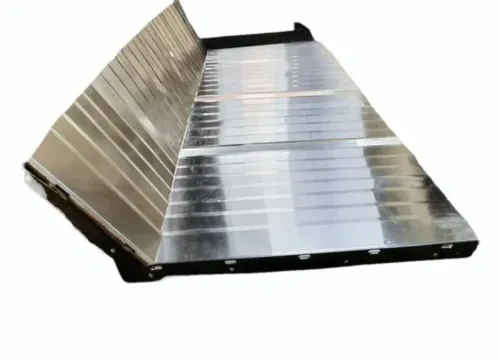
| Metal-flap bellow | Sharper chips and greater abrasion resistance than exposed fabric | Machining areas where chips strike the folds but a flexible cover still fits |
| Telescopic steel cover | Heavy, sharp or hot chips with strong impact protection | Hot-chip cutting, high coolant flow and rigid installations with sufficient space |
| Scraper-only arrangement | Loose contamination at the entry edge, not full rail protection | As a supplementary wiper where exposure is low; it does not replace a sealed cover |
| Uncovered guideway | No protection from chips, coolant or dust | Only where the rail is isolated from contamination or another enclosure provides equivalent protection |
A fabric bellow facing red-hot or sharp chips can burn, puncture or develop pinholes, so add a chip deflector, stainless-steel slats, protective lamellae or a steel cover ahead of it. Check acceleration, cycle frequency, mounting orientation and the cover’s minimum bend radius before accepting a compact design.
Do not match the cover to rail length alone. An oversized cover can buckle or rub at the stroke limit; an undersized one can become taut, load its mounts and expose the guideway. Run any replacement through the complete stroke at reduced speed, checking even folding, secure mounts and clearances at both limits.
Measure the Existing Cover Before Ordering a Replacement
A replacement cover must match the axis motion envelope, not just the rail length. Measure it fully extended and fully compressed; an oversized cover can buckle or rub at the limit, while an undersized one can become taut and expose the guideway.
For an LM guideway bellow cover replacement in Kolhapur, send photographs and provide:
- Fully extended length, fully compressed length, folded height and overall width
- Axis stroke, moving-carriage clearance and clearance from cable carriers or neighbouring covers
- Mounting-hole pattern, flange dimensions, fixing direction and operating orientation
- Approximate travel speed, acceleration, cycle frequency and minimum bend radius
- Coolant type, chip size and chip temperature, plus welding sparks or abrasive dust if present
| Dimension | What to measure | Fault prevented |
|---|---|---|
| Extended length | Cover at maximum open position | Guideway exposure before full travel |
| Compressed length | Cover fully folded without forcing it | Buckling, rubbing and excess fold pressure |
| Width and folded height | Outside profile beside the carriage | Snagging on guards, cables or adjacent covers |
| Mounting details | Hole centres, flange size and available depth | Loose fixings or an impossible installation |
| Clearances | Rail, carriage, covers and cable carriers | Contact throughout the stroke |
Give Kalavijay Engineering these measurements rather than only a Hiwin, THK or machine model; the model rarely reveals installation clearances or the existing cover’s actual travel. After fitting, run the axis slowly through its complete stroke and check that every fold opens evenly, stays secure and never becomes taut.
Related products
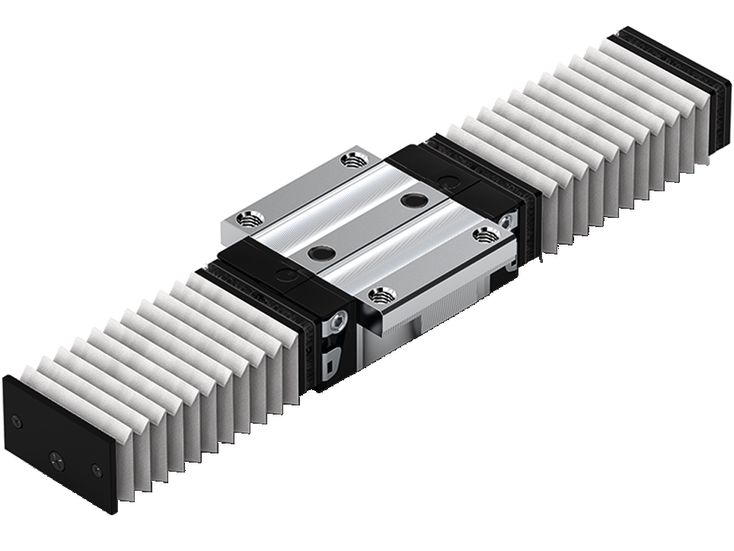 | Bellow Cover We are munufacturer for Custimized LM Rail Bellow Cover. Liner Bearing Bellow Cover If You Want To Protect Your Hiwin, THK, GRI, Linear Bearings And... View product → |
 | Bellow Cover We, " KALAVIJAY ENGINEERING" are masters in manufacturing and supplying excellent quality of LM Rail Bellows covers. View product → |
Inspect, Clean and Test the Bellow Through Its Full Stroke
Inspect an LM guideway bellow with the axis stopped and energy isolated, then clean it before checking movement. Extend the cover and examine the outside and inside of every fold; trapped chips can stay hidden when the bellow is fully open. This is the core of lm guideway bellow maintenance.
Look for:
- Pinholes, cuts, delamination, cracked coatings or coolant-swollen fabric
- Loose stitching, detached mounting strips and distorted folds
- Shiny rubbing marks on the cover, rail or carriage
- Chips lodged inside folds or at open ends
- Gaps around wipers, fasteners and mounting plates
Remove chips with a vacuum or soft brush, and wipe coolant residue with a material-compatible cleaner. Do not force debris deeper into a fold or use a solvent that attacks the coating, adhesive or seal.
After fitting a new or repaired cover, run the axis through its complete programmed stroke at reduced speed before production. Watch from the side and stop immediately if a fold catches, the cover rubs the rail or carriage, or a mounting point shifts.
At both travel limits, every fold must open evenly without buckling, snagging or becoming taut. Check that the cover does not pull on its mounts or expose the guideway before the commanded endpoint.
Repeat the check at normal acceleration only after the slow pass is clean, because acceleration can reveal a fault that steady travel misses.
Frequently asked questions
How does an LM guideway bellow cover keep machine movement clean?
Its folded sections expand and contract with the carriage, shielding the guideway from chips, coolant and airborne dust without entering the bearing path.
What movement problems can an LM guideway bellow cover prevent?
A correctly fitted cover reduces contamination reaching the guideway, but it cannot correct rail misalignment, damaged bearings, poor lubrication or incorrect preload.
How do you choose an LM guideway bellow cover construction?
Match the fabric, coatings, seals and reinforcement to the hazard, including chips, coolant, heat, sparks, UV exposure and the axis motion envelope.
What should you measure before ordering an LM guideway bellow cover replacement?
Record the cover width, folded height, extended length, number of folds, mounting-hole locations, flange dimensions and the available clearance throughout the stroke.