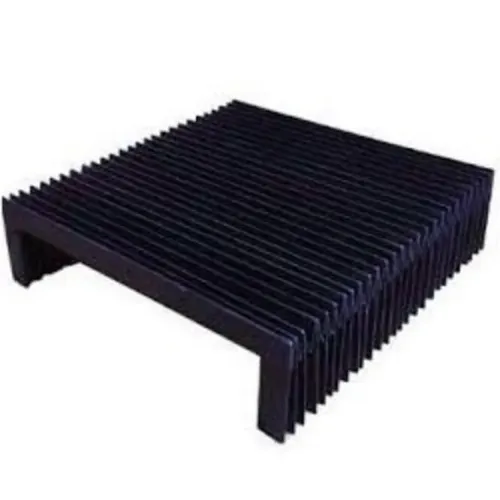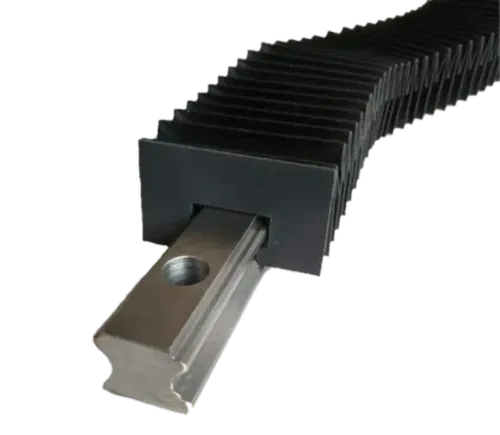

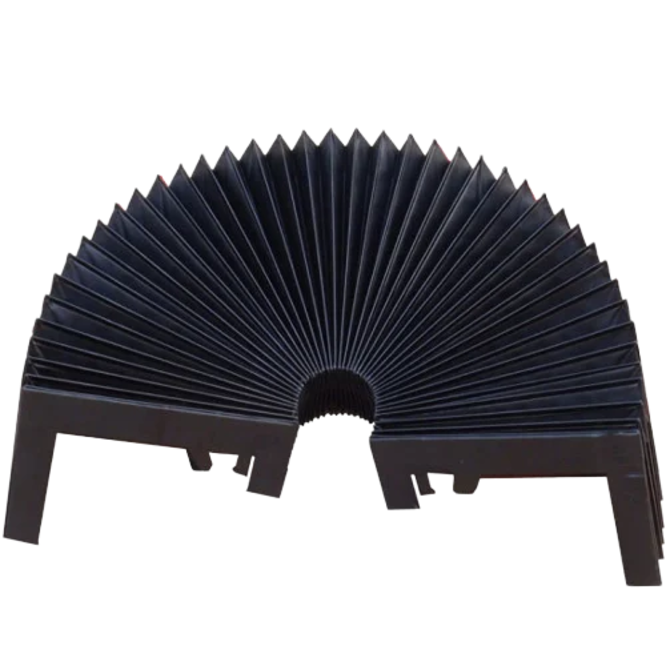
A moving fabric bellow cover can build charge as its folds rub against guideways, chips, coolant residue, and adjacent machine parts. By the end, you will know how to identify static symptoms, specify a suitable fabric construction, verify its resistance and grounding path, and test whether protection still works during machine movement.
Key takeaways
- Dry air and repeated folding can trap charge in a moving fabric bellows cover.
- Choose dissipative or conductive fabric when charge must reach machine earth.
- Use a short, flexible bonding path and verify resistance on the finished cover.
- Fix sharp edges, contamination, and poor clearances when static is not the root cause.
How a Moving Bellow Cover Builds and Releases Static Charge
A moving fabric bellow cover accumulates charge when repeated contact transfers electrons between surfaces. Folding rubs the fabric against itself, while sliding creates friction against nearby machine surfaces. Dry air slows charge leakage, and an insulating guideway or coolant residue can leave the charge trapped.
Protective earthing on the machine does not automatically place moving fabric at earth potential.
Charge builds through:
- Fabric-to-fabric contact as folds open, close, and press together.
- Fabric-to-guideway contact as the cover travels over rails or support surfaces.
- Fabric-to-chip contact when swarf moves across the cover or becomes trapped in a fold.
That is the mechanism behind many machine bellow cover static issues. The result can be a sudden electrostatic discharge that resets or damages a sensor, controller, or nearby electronic component. A charged cover also attracts dust and chips, increasing contamination and abrasion. Around flammable vapour or combustible dust, a spark can ignite the atmosphere.
Effective fabric bellow cover static protection therefore requires more than a conductive textile: the finished cover needs a continuous, controlled route for charge to leave. Static control also does not replace protective bonding or make the cover safe near live electrical parts.
The Symptoms That Point to a Static Problem
Static is likely when debris follows the cover’s movement and the symptoms change with humidity, stroke speed, coolant residue, or dust loading. A fault in a sensor or cable usually stays tied to that circuit, regardless of whether the bellow is moving.
Look for these practical signs:
- Fine chips, abrasive dust, or lint cling to the pleats instead of falling away during retraction.
- A small spark, snap, or visible discharge appears near a metal frame, sensor, fastener, or guideway.
- A nearby sensor resets, gives false readings, or loses communication precisely as the cover moves.
- Dust suddenly adheres after a dry spell, heated operation, or frequent sliding contact.
Check the pattern before ordering an anti-static replacement. If the interference continues with the cover stationary, inspect cable shielding, sensor supply voltage, machine grounding, and electromagnetic interference. A grounding lead attached at one end also does not prove continuity through every fold, seam, or moving section.
For machine bellow cover static issues, record temperature, relative humidity, coolant type, washdown practice, stroke frequency, and chip loading when the symptom appears. That record separates genuine anti-static bellow cover problems from contamination, mechanical rubbing, or a failed electrical connection.
Anti-Static, Dissipative, Conductive, or Insulating: Which Property Do You Need?
“Anti-static” describes an intended effect, not a measurable performance level. A fabric bellow cover static protection specification must state how charge moves, how quickly it decays, and where it goes.
| Property | Electrical behaviour | Typical purpose |
|---|---|---|
| Insulating | Resists current flow and retains charge | Electrical isolation; can worsen dust attraction and discharge |
| Dissipative | Releases charge slowly through a controlled resistance | Reducing charge accumulation without creating a low-resistance path |
| Conductive | Carries charge readily through low resistance | Rapid charge transfer when bonding and grounding are engineered |
| Antistatic | General claim that charge buildup is reduced | Not a defined resistance range or grounding method |
The phrase “anti static fabric bellow cover for static problems in Kolhapur” describes a requirement, not a product category. Temperature, humidity, coolant, washdown chemicals, stroke frequency, and chip loading determine whether the property survives service; test those conditions rather than treating Kolhapur as a specification.
Ask for surface resistance, volume resistance, resistance-to-ground, or charge-decay time, plus the test method, applied voltage, conditioning humidity, and acceptance limit. Confirm continuity across seams, coatings, fittings, and moving folds. A conductive fabric without a reliable bond to machine earth may still discharge unpredictably.
Static control also does not replace protective bonding or make the cover safe near live electrical parts. Conversely, a low-resistance cover is wrong where electrical isolation is required.
How to Give Charge a Reliable Path to Machine Earth
A conductive or dissipative fabric bellow needs bonding to machine earth; conductivity alone does not drain charge. A painted end frame, insulating clamp, coating gap, folded seam allowance, or loose strap can leave the moving fabric electrically floating. That is the root of many anti-static bellow cover problems and machine bellow cover static issues.
- Specify a dedicated bonding lead from the conductive fabric or its bonded reinforcement to the machine grounding point. Do not rely on contact through paint, grease, a guideway, or a mounting bolt.
- Use conductive fasteners, washers, or bonding tabs at each end frame, and remove paint or coating at the intended earth contact. Protect the connection against coolant, vibration, and corrosion.
- Check every stitched, welded, or overlaid seam. A nonconductive thread, seam tape, reinforcement strip, or coating can divide the cover into isolated sections.
- Bond long or pleated covers at more than one suitable location when the construction requires it. A strap fixed to one end does not prove that every active fold remains connected.
- Measure resistance from representative points on the extended and compressed cover to the machine grounding point. Move the cover through its full stroke while checking the bonding strap, sliding contact, cable loop, and fittings for interruptions.
This static-control bond does not replace protective bonding or make the cover safe near live electrical parts. Record the arrangement and inspect it after washdown, coolant exposure, and repeated cycling.
How to Verify Static Protection on the Finished Cover
Do not accept a cover because its fabric certificate says “anti-static.” Require measurements on the finished assembly, with the test method, applied voltage, temperature, relative humidity, conditioning time, and acceptance limit recorded.
An anti static fabric bellow cover in kolhapur must be tested under the humidity and temperature it will face, not only in a supplier’s controlled room.
- Measure surface resistance between defined electrodes, volume resistance through the material, and resistance-to-ground from every accessible panel to the intended earth connection. Record charge-decay time when the risk involves electronic discharge or dust attraction.
- Repeat the measurements after drying, heating, coolant exposure, washdown, and representative dust or chip loading. State the coolant type, seasonal humidity, stroke frequency, and storage conditions in the test plan.
- Inspect stitched or welded seams, cut edges, overlays, reinforcement strips, end plates, eyelets, and mounting hardware. Test across each joint; a conductive fabric is ineffective if a seam or fitting interrupts continuity.
- Operate the installed cover through its full stroke for a documented cycle count at normal speed. Measure resistance during extension and compression, then inspect for cracking, rubbing, loose bonds, and intermittent earth continuity.
Kalavijay Engineering should provide this finished-cover evidence when specifying an anti static fabric bellow cover for static problems in kolhapur, rather than relying on a roll certificate. A low resistance result does not replace protective bonding or prove suitability near live electrical parts.
| Resistance property | What to record | Failure sign |
|---|---|---|
| Surface, volume, or ground resistance | Method, voltage, humidity, temperature, limit | Unspecified result or open circuit |
| Charge decay | Time and test charge | Charge remains after the stated limit |
| Movement continuity | Stroke, cycles, speed, readings | Resistance changes or earth path breaks |
Related product
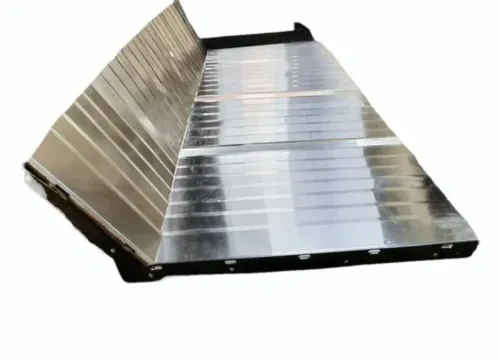
 | Bellow Cover Anti Static Fabric Bellow Cover Kalavijay Engineering is considered a renowned name in the field that manufactures and supplies Steel Telescopic Cover. View product → |
When Static Control Is the Wrong or Incomplete Fix
A low-resistance cover is not a universal cure. Define the failure you are preventing before selecting fabric, because a construction that dissipates charge can defeat required electrical isolation.
| Option | Choose when | Do not assume |
|---|---|---|
| Sensitive electronics | Discharges disturb sensors, drives, or control boards | Static fabric replaces cable shielding, grounding, or EMC checks |
| Flammable dust or vapour | The cover forms part of an ignition-control system | “Anti-static” wording equals ATEX or hazardous-area approval |
| Coolant exposure | Coolant residue changes surface resistance or causes leakage paths | A dry laboratory result remains valid after washdown |
| Heavy abrasion | Chips and guideway contact wear the coating or conductive layer | Conductivity survives the specified stroke cycle |
| Electrical isolation | The cover must separate live parts from the operator or frame | A conductive cover is safe near live electrical parts |
Troubleshoot anti-static bellow cover problems by checking bonding, cable shields, coolant contamination, and electromagnetic interference before replacing fabric. Repeat resistance and continuity tests after the actual stroke frequency, humidity, coolant, washdown routine, and chip loading have been applied.
For an anti static fabric bellow cover in Kolhapur, put seasonal humidity and local operating conditions into the test plan, not the product label. Specify the required resistance range and isolation voltage separately. When flammable materials are present, obtain hazardous-area engineering review before installation.
Frequently asked questions
How does a moving fabric bellows cover build static charge?
Repeated folding, sliding, and contact between fabric and machine surfaces transfer electrons. Dry air, insulating guideways, and residue slow charge leakage.
What symptoms indicate a static problem in a fabric bellows cover?
Look for small shocks, visible sparks, dust attraction, electronic resets, erratic sensors, and charge readings that rise during repeated cover movement.
Should you choose anti-static, dissipative, conductive, or insulating fabric?
Choose dissipative fabric for controlled charge release, conductive fabric when you need a lower-resistance path to earth, and insulating fabric only when electrical isolation is the priority.
How do you give a fabric bellows cover a reliable path to machine earth?
Use a flexible bonding lead, secure it to a clean metal earth point, protect it from flexing damage, and confirm continuity through the cover and machine frame.
How can you verify static protection on the finished cover?
Measure resistance from the cover’s working surfaces to the earth connection, repeat the test while moving the cover, and inspect for broken bonds or intermittent readings.