
A replacement cover is worth the money only when it prevents a larger repair bill without creating new clearance, alignment, or cleaning problems. By comparing failure costs, cover construction, machine measurements, supplier claims, and installation risks, you can decide whether to buy an OEM part, a matched custom cover, or a different protection system.
Key takeaways
- Compare the cover cost with one guideway repair and its production downtime.
- Choose stainless-steel lamellae for hot chips, sparks, or severe coolant exposure.
- Measure travel, folded length, height, width, and mounting points before ordering.
- Confirm whether the part is OEM, matched custom, or universal before installation.
When does a DMG Mori bellow cover pay for itself?
A DMG Mori bellow cover pays for itself when its purchase and installation cost is lower than one avoidable guideway or ball-screw repair, plus the production time lost during that repair. Calculate the decision against the machine’s failure history, not against the cover’s invoice alone.
Include these costs in your comparison:
- Guideway damage from chips, coolant sludge, or failed wipers; scoring the ways can turn a cover replacement into a precision-reconditioning job.
- Ball-screw contamination; abrasive particles can increase backlash, wear the nut, and shorten the screw’s service life.
- Downtime for diagnosis, removal, fitting, alignment, and test cuts, including the value of jobs that cannot run.
- Cleaning labour after every shift or washdown; trapped chips on the folds can be dragged into the machine and cut the fabric during repeated reversals.
- Repeat failure caused by blocked drains, bent end frames, misaligned rails, damaged wipers, or a cover that is too long when compressed.
A low-priced replacement is not economical if it repeats the original failure. Before ordering a dmg mori machine bellow cover in kolhapur, record the machine model, axis, mounting-hole pattern, travel, and fully compressed length; insufficient clearance can make the cover strike the enclosure, spindle head, limit switch, or adjacent cover.
Confirm whether the part is an OEM replacement, an approved substitute, or a custom component, then check warranty and service-agreement conditions. A custom cover is financially sensible for obsolete or modified machines only when its geometry preserves chip shedding, clearances, and support arrangements.
When are stainless-steel lamellae worth the extra cost?
Stainless-steel lamellae are worth the extra cost when chips are sharp, hot, heavy, or thrown at the cover during rapid axis movement. Basic PU-coated fabric suits coolant mist, dust, and light chips; using it against aggressive debris can cause punctures, trapped chips, and exposed guideways.
Choose the protection that matches the hazard:
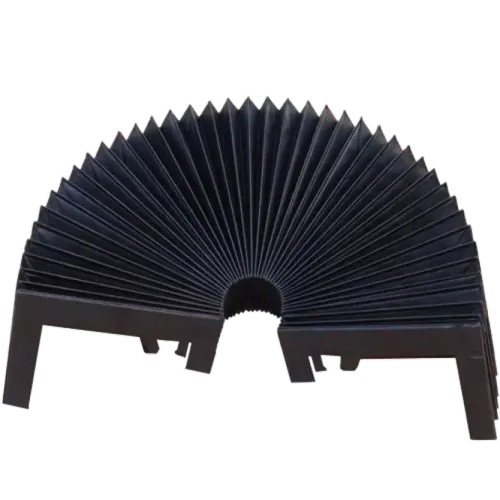
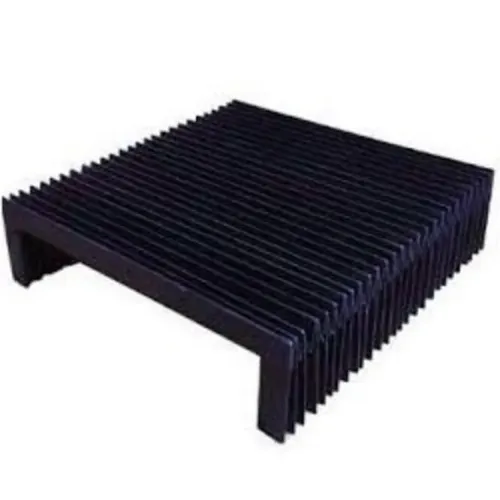
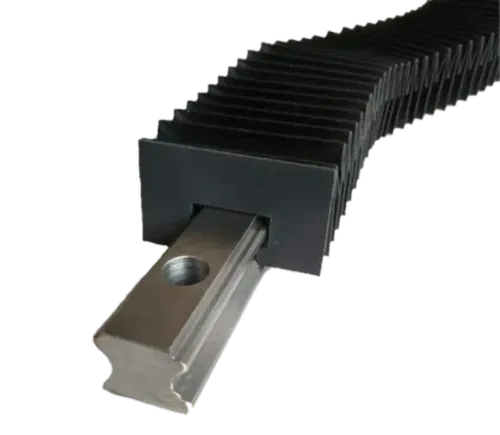
- Reinforced fabric fits moderate chip loads when flexibility, low weight, and compact folding matter more than impact resistance.
- Internal slats suit covers that need extra support against sagging, scraping contact, or chips pressing between folds.
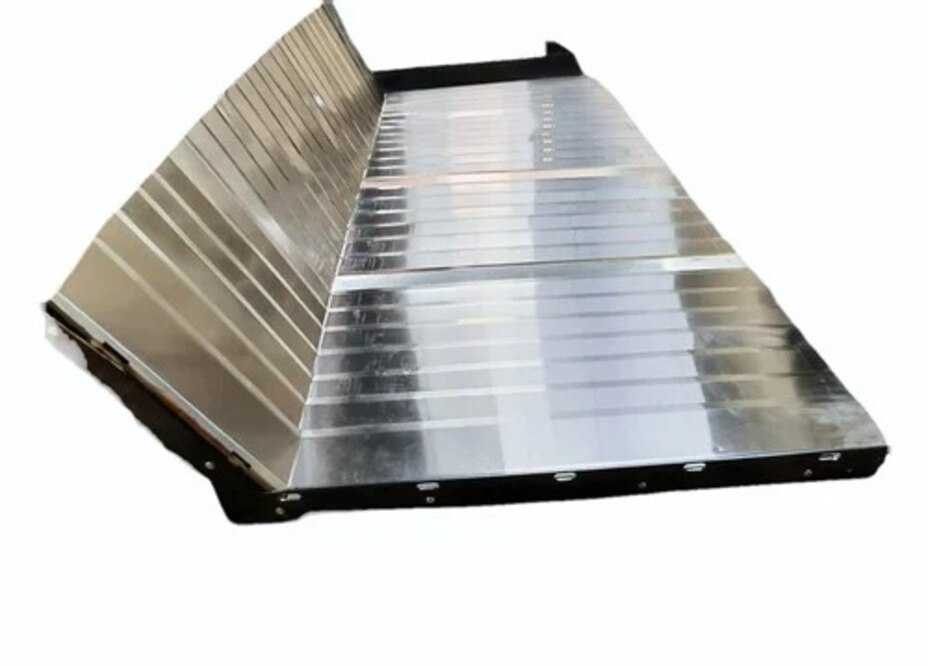
- Stainless-steel lamellae suit sharp steel chips, hot swarf, wet sludge, frequent high-pressure washdown, and repeated contact with chips. Check the lamella overlap and wiper design; gaps can carry debris underneath.
- A steel apron suits straight, exposed travel where chips fall directly onto the cover and the machine has enough clearance for rigid overlapping plates.
- A telescopic steel cover is the better choice for very high chip volume, high cutting-fluid pressure, fast travel, high acceleration, or continuous scraping. Do not force a bellows design into that duty.
Review chip temperature, size, coolant chemistry, travel speed, acceleration, and washdown frequency together. High-pressure coolant can penetrate stitching and end-frame joints even when the fabric coating is chemically compatible, so require seam construction, drainage, and washdown-test details in the quotation.
Before ordering a dmg mori bellow cover in kolhapur, confirm that stainless lamellae will not reduce folded clearance or interfere with limit switches, wipers, or adjacent covers. A heavier cover can also increase drive load.
What measurements must you take before ordering?
Do not order from the machine model alone. Identify the exact axis, enclosure version, and travel direction, then measure the installed cover in both end positions without removing guideways, guards, or limit switches.
1. Record the DMG Mori model, production year if available, axis name, and whether the cover moves with the table, saddle, or spindle head. Photograph the fixed end, moving end, guide arrangement, coolant direction, and every nearby obstruction.
2. Measure the cover’s overall width, folded height, cross-section, fold pitch, and travel. Record fully compressed length and fully extended length separately; a cover that reaches the required travel can still collide when compressed with the enclosure, spindle head, limit switch, or adjacent cover.
3. Measure the mounting-hole pattern at both ends: hole count, centre-to-centre spacing, hole diameter, flange dimensions, bolt direction, and the distance from each mounting face to the first fold. Note fixed and moving ends clearly.
4. With the machine stopped at each travel limit, measure clearance above, below, and beside the cover. Mark guide rails, wipers, cable carriers, lubrication lines, doors, chips guards, and any point where the folds rub, twist, or open against an obstruction.
5. Draw the travel direction and cross-section, including folded height, support rails, end-frame geometry, and obstructions. Add the largest chip or burr size and the direction of coolant flow.
The phrase “DMG Mori machine bellow cover in Kolhapur” does not identify a standard replacement. Supply these measurements with photographs, but do not rely on photographs alone; incomplete dimensions can produce a custom cover with the wrong clearances or fold geometry.
Is the proposed part OEM, matched custom, or universal?
The search phrase “DMG Mori bellow cover in Kolhapur” does not prove authorised OEM status. Ask whether the proposal is an OEM replacement, an approved substitute, or a locally manufactured custom component, then check whether your machine warranty or service agreement permits substitution.
| Option | Interchangeability | Warranty and use |
|---|---|---|
| OEM replacement | Matches the specified machine, axis, mounting pattern, and geometry | Best where warranty, service records, or OEM support control the decision |
| Matched custom cover | Built from verified measurements and drawings | Suitable for obsolete parts or modified machines; fit errors can affect clearances and chip shedding |
| Universal cover | Adapted across machines or axes | Lowest confidence; accept it only after confirming every interface and movement limit |
For a custom bellow cover in Kolhapur, “same size” and “equivalent quality” are not acceptance criteria.
Require the quotation to state material construction, coating or laminate, operating-temperature range, coolant compatibility, maximum travel speed, expected cycle or service basis, compressed and extended lengths, fold pitch, mounting-hole pattern, warranty exclusions, delivery time, and whether a template or site measurement is included.
If high-pressure coolant is present, request seam construction, end-frame joint details, drainage provisions, and washdown-test conditions; compatible fabric alone does not prevent leakage through stitching. Kalavijay Engineering can be evaluated on the same evidence. Do not release the order until the quotation identifies the DMG Mori model, axis, clearances, guide arrangement, and interference points.
Related product
 | Bellow Cover We are Manufacturing SS Metal Flap Bellow Covers for DMG Mori Machine. View product → |
What installation and maintenance checks determine the final decision?
Approve the replacement only after a trial-fit inspection proves that it moves freely, protects the guideway, and remains serviceable. A custom bellow cover in kolhapur is not acceptable on dimensions alone; incomplete clearances can create a new failure.
1. Run the axis through its full programmed travel at slow speed, then at production speed. Check every fold for stretching, rubbing, buckling, and contact with the spindle head, enclosure, limit switch, or adjacent cover.
2. Confirm that the compressed length leaves clearance at both end positions. A cover that reaches full extension but strikes the enclosure when folded will restrict travel or tear during reversals.
3. Open the access panels and operate the lubrication system. You must reach grease points, oil lines, fittings, wipers, and inspection areas without removing the cover.
4. Run chips and coolant through the normal cutting cycle. Chips must slide off the slope rather than collect in folds; trapped chips can cut fabric or enter the guideway.
5. Wash the cover using the plant’s actual coolant and washdown method. Inspect seals, stitched corners, lamella joints, and mounting brackets for leakage, lifting, or deformation afterward.
6. Mark pinch zones, hot surfaces, moving edges, and guard boundaries before release. Verify that the cover cannot obstruct an emergency stop, interlock, operator sightline, or maintenance route.
Choose a telescopic steel cover, reinforced fabric bellows, or another scraper arrangement when chips scrape continuously, hot burrs pierce the folds, or the travel geometry prevents clean folding. That result is better than forcing a bellow design to fit.
Frequently asked questions
When does a DMG Mori bellow cover pay for itself?
It pays for itself when its purchase and installation cost is lower than one avoidable guideway or ball-screw repair plus the production time lost during that repair. Use your machine’s failure history and downtime cost, not the cover invoice alone.
When are stainless-steel lamellae worth the extra cost?
Specify stainless-steel lamellae when the machine faces hot chips, welding sparks, abrasive debris, or aggressive coolant. Compare the added cost with the damage those hazards could cause to the bellows and guideway.
What measurements must you take before ordering?
Record the cover’s working travel, compressed or folded length, extended length, height, width, mounting-hole locations, mounting-face orientation, and available clearance throughout the machine stroke.
Is the proposed part OEM, matched custom, or universal?
Ask the supplier to identify the part as an OEM replacement, a matched custom cover built from your measurements, or a universal cover. Confirm material, dimensions, mounting details, and machine compatibility in writing.
What installation and maintenance checks determine the final decision?
Check mounting alignment, full travel, folding movement, clearance, chip removal, coolant drainage, fastener security, and fabric or lamella damage after installation. Include routine cleaning and inspection in the ownership decision.