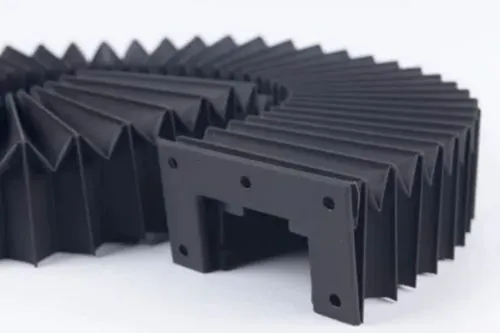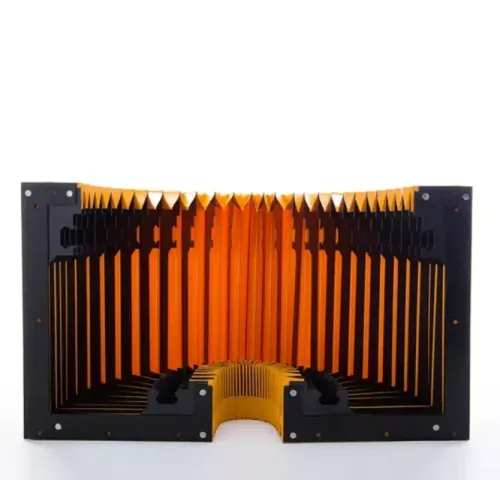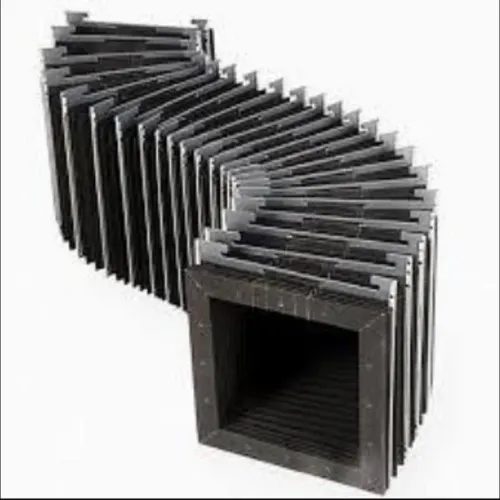

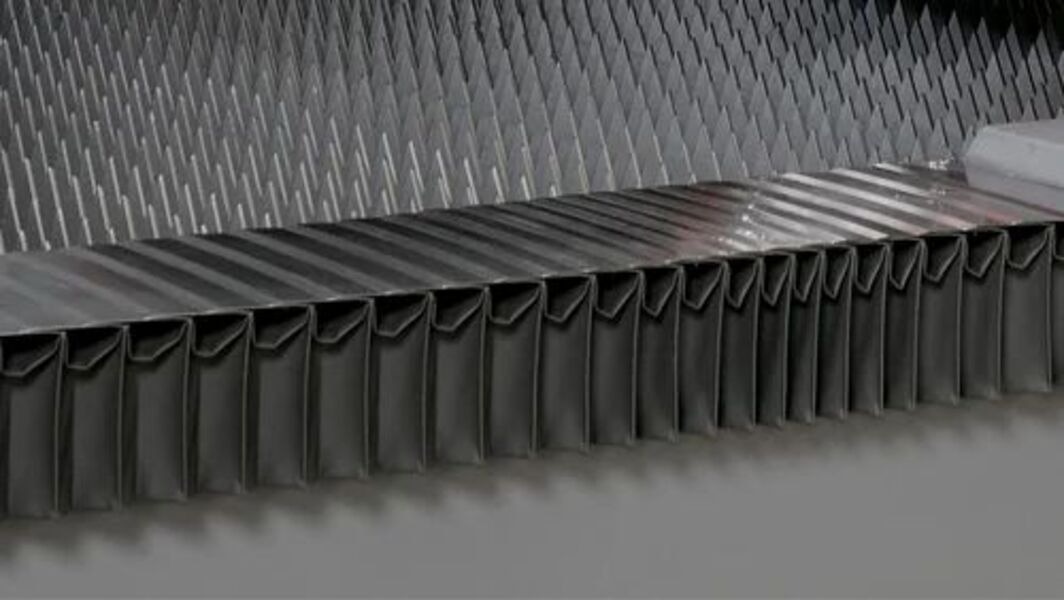
The two covers protect different parts of a laser machine, so choosing by appearance or price can leave the guideway, screw, nut, or return path exposed. By comparing mounting position, exposure, movement, dimensions, and failure risks, you can identify whether you need an axis bellow, a dedicated ball-screw cover, or both before requesting a replacement in Pune.
Key takeaways
- Axis bellows shield guides and moving assemblies from chips, coolant, sparks, and heat.
- Ball-screw covers protect the screw, nut, and lubrication film from contamination.
- Use machine model, axis, dimensions, travel, and mounting details to specify replacements.
- Inspect clearance, fasteners, folds, seals, and travel after installing either cover.
What each cover protects on a Prima laser machine
No. A Prima laser machine bellow cover and a ball screw protection cover are different protection choices, although one engineered bellows assembly can sometimes protect both a guideway and a ball screw.
“Prima laser machine bellow cover” is usually a buyer’s search phrase, not enough information to identify an exact model or replacement part. Confirm the machine identification, protected axis, mounting points, travel, folded length, and clearance before treating it as an interchangeable cover.
| Protection type | Mounting area | Main protection |
|---|---|---|
| Axis bellows | Between the fixed frame and moving carriage | Guideways, slideways, and enclosed linear motion from dust, slag, sparks, coolant, and cutting residue |
| Ball-screw cover | Around or alongside the screw and ball nut | Screw threads, nut, return path, lubricant, and exposed drive components from abrasive fines and falling debris |
| Way wiper | At the moving contact with a guide surface | Removes contamination at the interface; it does not enclose the screw or stop debris from reaching it |
A guideway bellows placed near a ball screw does not automatically seal the screw thread or ball-nut return path. The bellows needs screw-specific geometry, attachment points, stroke, folded length, and clearance; otherwise it can rub, restrict travel, or leave the drive exposed.
For a Prima laser machine bellow cover versus ball screw protection in Pune, compare the axis being protected, exposure, available envelope, acceleration, cleaning method, and replacement lead time. A prima laser machine bellow cover comparison in Pune is incomplete if it compares price without checking whether the screw remains exposed.
Use both covers when the bellows shields the guideway but falling debris can still reach an exposed ball screw. Extraction airflow also matters: unsupported bellows can balloon, collapse, or flap against moving parts.
Where Prima laser-machine bellows are used and what they must withstand
Protect the X-, Y-, and Z-axis guideways first: these surfaces carry the carriage and cutting head through dust, slag, and lubricant-contaminated air. Prima laser machine bellow cover applications also include carriage-mounted slideways, beam or nozzle-axis mechanisms, and enclosed linear motion around the cutting head.
| Protection choice | Mounting zone | What it must withstand |
|---|---|---|
| Axis bellow | Between fixed frames and a moving carriage or guideway | Repeated folding, high acceleration, abrasive fines, coolant or oil mist, sparks, and occasional hot dross |
| Ball-screw cover | Around an exposed screw, nut, and return path | Falling debris, laser dust, lubricant loss, impact, and contamination entering the screw threads |
| Both covers | Axis guideway plus a separately exposed screw | Combined exposure where the bellow does not enclose the screw completely |
A ball-screw cover cannot replace a complete axis bellow when guideways remain open. Likewise, a guideway bellow leaves the screw vulnerable if debris can fall behind its folds or enter through the carriage opening.
Check the cover against extraction airflow and pressure changes. Suction can make unsupported bellows balloon, collapse, flap, or rub the screw and guideway. Correct fold geometry, guided support, sealed seams, rigid end frames, and adequate clearance matter more than simply choosing thicker fabric.
Inspect the likely damage points before specifying material:
- Fold cracking or delamination from repeated cycling
- Torn corners and pulled fasteners at the frame
- Abrasion from contact during acceleration
- Heat damage where sparks or dross reach the folds
When to choose an axis bellow, a ball-screw cover, or both
Choose an axis bellow when the guideway, carriage, or moving axis needs continuous flexible protection; choose a dedicated screw cover when the ball screw remains exposed; choose both when one cover does not shield the other.
| Option | What it protects | When it applies |
|---|---|---|
| Flexible axis bellow | Guideways, slideways, and the moving axis envelope | Use it where the cover must fold with X-, Y-, or Z-axis travel and fit a tight space |
| Ball-screw protection cover | Screw, nut, and return system from fines, chips, lubricant loss, and falling debris | Add it when the screw sits outside the bellow’s protected zone |
| Telescopic steel cover | Rigid guideways or screw assemblies against impact, hot particles, and heavy debris | Use it where space permits nested sections and the cover can tolerate added mass |
| Way wipers | The guided surface at the carriage interface | Use them with a cover to remove residue; they are not a substitute for enclosing an exposed screw |
Select the material from the actual exposure: coated fabric for flexible movement, stainless or coated steel for rigid protection, and heat-resistant construction where sparks or slag reach the cover. Check extraction airflow, pressure changes, axis acceleration, cleaning access, and replacement lead time; a weakly supported bellow can balloon, collapse, flap, or rub.
A ball screw protection cover in Pune is not automatically interchangeable with an axis bellow. In a prima laser machine bellow cover comparison in Pune, choose both when the bellow shields the guideway but leaves the screw visible.
How to identify the Prima machine and specify the replacement
A supplier can match the replacement accurately from the machine nameplate, mounting geometry, travel, and exposure details—not from the old cover alone. For a Prima laser machine bellow cover versus ball screw protection in Pune decision, send these details:
1. Photograph the complete machine nameplate, showing Prima’s model, serial number, axis configuration, and manufacturing details. Add clear photographs of the installed cover, both mounting ends, the exposed guideway or screw, and the surrounding clearance.
2. Measure the required cover while the axis is at both limits. Record extended length, compressed or folded length, usable stroke, width, height, fold pitch, mounting-frame thickness, and flange dimensions. Measure hole diameter, hole spacing, bolt pattern, and the distance from the mounting face to the guideway or screw centreline.
3. If the replacement is a ball screw protection cover in Pune, record screw diameter, nut length and width, return-tube position, bearing-support clearance, screw orientation, and the space available above and below the assembly. A guideway bellows cannot be assumed to shield the nut or return path.
4. State the axis—X, Y, or Z—its approximate speed and acceleration, and whether the cover moves with the carriage. Include cutting material, dust or slag load, sparks, coolant or lubricant, extraction airflow, cleaning method, and the reason for failure. Note any rubbing, ballooning, tearing, or restricted travel.
Kalavijay Engineering can use these measurements to separate a complete axis cover from a local screw cover before fabrication, avoiding a visually similar part that blocks travel.
What to inspect after installation and during maintenance
Run the axis through its full programmed travel immediately after installation and again after maintenance. A cover that bunches before the end position, pulls on its mounts, or prevents the carriage reaching its limit is too short, incorrectly tensioned, or dimensioned for the wrong folded height.
Check these points with power isolated where the machine procedure permits:
- Confirm the bellows folds open evenly without rubbing the guideway, screw, nut, cable carrier, nozzle assembly, or enclosure.
- Measure clearance around the ball-screw nut, lubrication fittings, recirculation tubes, and end bearings; blocked access is an installation failure.
- Observe the cover during extraction changes. Ballooning, collapse, flapping, or suction-driven rubbing means the support or airflow relief is inadequate.
- Inspect every fold for chips, slag, abrasive dust, oil, coolant, pinholes, torn fabric, cracked coating, and loose fasteners.
| Finding | What it indicates | Action |
|---|---|---|
| Travel stops early or mounts pull | Cover restricts motion | Stop operation; verify travel, folded height, and tension |
| Screw is clean but nut cannot reach its end position | Local cover is too short or obstructs the nut | Recheck nut clearance and full travel |
| Debris appears behind the cover | Fold, seal, or mounting has failed | Clean, locate the entry path, and replace damaged material |
| Uneven folds or repeated shiny rub marks | Misalignment, sag, or airflow movement | Realign supports and inspect adjacent moving parts |
Across prima laser machine bellow cover applications, repeated rubbing or debris ingress is evidence that the selected protection is not performing, even if the axis still moves.
Frequently asked questions
What does an axis bellow protect on a Prima laser machine?
An axis bellow protects guideways and moving axis components from chips, coolant, dust, sparks, heat, and mechanical wear.
What does a ball-screw protection cover protect?
A ball-screw protection cover shields the screw and nut from abrasive debris, coolant, oil contamination, and damage to the lubrication film.
When should you choose an axis bellow, a ball-screw cover, or both?
Choose an axis bellow for exposed guideways, a ball-screw cover for an exposed screw and nut, and both when each component needs separate protection.
How do you specify a replacement Prima laser-machine bellow?
Record the Prima machine model, protected axis, compressed and extended lengths, width, height, travel, mounting pattern, fold size, material, and operating hazards.
What should you inspect after installing a protective cover?
Run the axis through its full travel and check clearance, smooth folding, mounting security, seals, rubbing, trapped debris, and interference with cables or tooling.